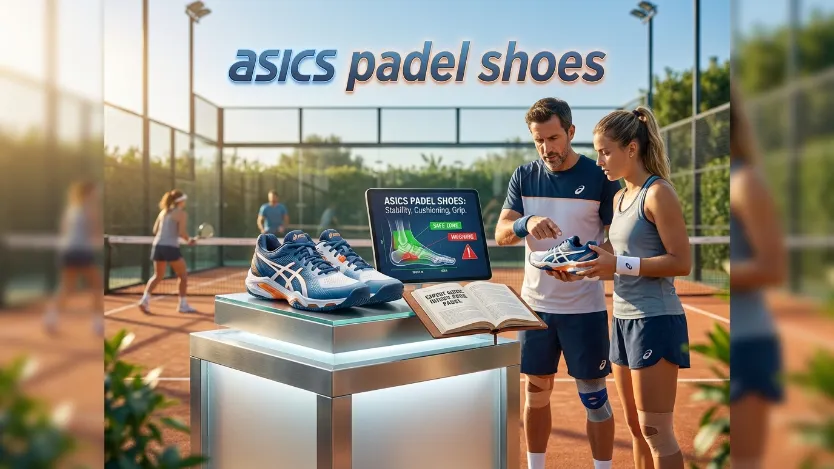
Imagine sprinting for a deep lob at your local Bexley Padel Club, only to feel your ankle roll because you are wearing standard running trainers. For many British players, this is a painful reality. The rise of padel in the UK has outpaced the understanding of specialist equipment, and nothing is more vital for safety than your choice of asics padel shoes. Unlike running, which is linear, padel is a game of explosive lateral shifts, sharp pivots, and sudden stops. Wearing a shoe designed for the forward motion of a 5k park run on an abrasive, sand-filled artificial grass court is a recipe for both injury and gear failure.
ASICS has long been the gold standard in court footwear, effectively porting their dominance in tennis into the asics shoes padel market. However, for the UK audience, choosing the right pair involves more than just picking a colour. You need to navigate the nuances of British weather, varying court surfaces from old-school sandy turf to modern “Mondo” grass, and technical quirks that most major retailers fail to mention. This guide provides an expert-level deep dive into the ASICS hierarchy, addresses the “information gaps” found on major sites, and ensures you get the maximum value for every pound spent.
The ASICS Padel Hierarchy: From Entry-Level to Pro
ASICS categorises their trainers based on the intensity of play and the specific needs of the athlete. Whether you are just starting with a best padel racket for beginners or competing in LTA tournaments, there is a specific model tailored for you.
The Gateway Choice: asics gel dedicate 8 padel shoes
The asics gel dedicate 8 padel shoes are the most popular starting point for recreational players in the UK. Priced aggressively (often found around £55-£65), they provide the essential lateral stability required to stop the foot from sliding off the midsole platform during a wide lunge. The upper is constructed with synthetic leather overlays, which offer a more “locked-in” feel than the mesh uppers of running shoes.
- Pros: Exceptional value, lightweight (approx 319g), and excellent grip right out of the box.
- Cons: Lower durability for intensive players. If you play more than twice a week, the standard rubber outsole may wear smooth within 4-6 months.
- Niche Insight: Lab teardowns have noted that while the “GEL” branding is prominent, the actual unit in the Dedicate 8 is significantly smaller than in pro models, meaning the “impact protection” is mostly handled by the EVA foam rather than a thick gel pad.
The Mid-Range Battle: asics gel challenger 14 padel shoes vs. Challenger 13
The mid-tier is where the majority of regular UK club players find their perfect match. The asics gel challenger 14 padel shoes represent a significant technical shift from their predecessor. The 14 features DYNAWING technology in the sidewall, which provides a more rigid structure during forceful side-to-side movements. Players often report that the 14 feels lower to the ground, enhancing court feel and balance.
However, the Challenger 13 remains a cult favourite because of its WINGWALL construction. While slightly stiffer, some players find the 13 provides a more secure “cage” for the foot. When looking at the asics challenger 13 padel shoe price, it is often available as a clearance item between £60 and £80, making it a fantastic technical bargain if you can find your size in stock.
The Elite Tier: Gel-Resolution X and Solution Speed FF 3
For the “Baseline Grinder” who covers every inch of the court, the Gel-Resolution X (the 10th generation) is the undisputed king of stability. It is built to survive the high torque generated by advanced players. On the other end of the spectrum, the Solution Speed FF 3 is designed for the “All-Court” player who prioritises explosive speed and agility. It is significantly lighter but offers less lateral reinforcement, making it a riskier choice for those with a history of ankle sprains.
UK Court Surface Dynamics: Sandy vs. Mondo
One of the biggest information gaps in the UK market is the impact of court surface on shoe selection. The LTA padel guides highlight that many British clubs are upgrading to “Mondo” or sandless grass, but pages for asics padel shoes rarely explain what this means for your knees.
- Traditional Sandy Courts: Common in older UK clubs. These require a deep Clay/Herringbone sole to dig through the sand and grip the turf. Without this pattern, you will slide uncontrollably.
- Mondo / SuperCourt: These use curled grass fibres where the sand is almost invisible. On these courts, a deep clay sole can actually provide too much grip. This can lead to your foot “hooking” into the carpet, preventing a natural pivot and putting dangerous rotational stress on your ACL and meniscus.
- The Solution: If you play mostly indoors on Mondo courts, look for ASICS models with a Padel-specific or Hybrid sole, which uses shorter peaks and rotation points (pivots) to allow for safe turning.
Technical Deep Dive: The Gaps Competitors Miss
The 100-Hour Cushioning Rule
Most retailers tell you to replace your trainers when the tread wears out. This is misleading for padel. The EVA foam in the midsole of your asics shoes padel undergoes “material fatigue” long before the rubber outsole goes bald. For a player weighing 85kg+ playing twice a week, the cushioning effectively “dies” after approximately 100–150 hours of play. If you start feeling unexplained soreness in your knees or shins after matches, but your outsoles look brand new, your midsoles have likely collapsed. Don’t wait for a hole to appear; your joints will pay the price.
The Mystery “Clicking” or “Plop” Sound
A common complaint in player forums regarding new ASICS uppers (especially the Resolution and Challenger series) is a strange clicking or popping sound in the toe box area. This is not a manufacturing defect but rather the stiff synthetic material buckling inward before it has been properly “broken in.” This usually disappears after 3–5 intense sessions. To speed this up, wear your trainers around the house for a few hours before heading to the court.
Gait Analysis: Why Do Big Toe Holes Appear?
Are you constantly wearing through the top of your asics gel dedicate 8 padel shoes? This is often caused by a biomechanical issue called “extensor substitution.” If your calves are tight or your foot is sliding forward because the shoe is too big, your big toe will instinctively “claw” upward during the gait cycle, rubbing against the fabric. Padel coaching on proper footwork can help, but technically, using “Marathon Lacing” or applying a small amount of Shoe Goo to high-wear areas can extend the life of the upper.
Sizing and Fit Strategy for the British Market
ASICS has a reputation for a “narrow last,” which can be a nightmare for the average British foot. If your asics gel challenger 14 padel shoes feel tight across the bridge, simply sizing up isn’t always the answer. A shoe that is too long will cause your foot to jam into the front during sudden stops, leading to bruised toenails.
- The Half-Size Rule: Most UK players benefit from going half a size up from their standard shoe size to accommodate the swelling of the feet that occurs during a 90-minute match.
- The Marathon Knot: Use the extra eyelet at the top of the shoe (the one that looks out of place). This creates a “heel lock,” preventing your foot from sliding forward while still leaving room for your toes to breathe in the toe box.
- Wide Feet: If you have 2E or 4E width feet, the Gel-Resolution X tends to be slightly more accommodating than the older Solution Speed models, which are notoriously slim.
Maintenance in the British Climate
Playing padel in the UK often involves damp outdoor courts and abrasive sand. Proper maintenance is the difference between your trainers lasting six months or two.
- Sand is the Enemy: Sand acts like sandpaper between the stitching of your shoe and the fabric. After every match, use a soft brush to clear the sand from the seams. Slapping your trainers against each other isn’t enough; the fine dust needs to be removed.
- The Radiator Death Trap: If your shoes get wet during a rainy session at Stratford Padel Club, NEVER put them on a radiator. High heat dries out the adhesives, leading to “sole separation.” Instead, remove the insoles and stuff the trainers with newspaper, replacing the paper every 30 minutes until they are dry.
Smart Buying: asics challenger 13 padel shoe price Trends
UK retailers often run clearance cycles in November and January. If you are budget-conscious, tracking the asics challenger 13 padel shoe price during these months can save you up to 40%. Additionally, joining the OneASICS membership programme provides a 90-day trial period. This is a game-changer for padel; it allows you to actually play a set in the shoes and return them if they cause blisters—a level of protection you won’t get from most high-street sports shops.
Frequently Asked Questions (FAQ)
Can I use basketball shoes for padel?
While they offer great lateral support, basketball shoes are often too heavy and use rubber compounds designed for indoor wooden floors. In the UK, they will wear out “like butter” on abrasive artificial turf. asics padel shoes are much lighter and far more durable for outdoor play.
How many hours do padel trainers usually last?
For a regular player (3 times a week), expect 4–6 months of peak performance. Even if the grip is fine, the internal dampening usually fails after 100-150 hours. If your padel scoring is getting better but your knees are feeling worse, it is time for a new pair.
What is the best ASICS shoe for wide feet?
The asics gel dedicate 8 padel shoes and the Resolution X generally have a slightly wider toe box than the Solution Speed series. Always consider half a size up for comfort.
Is there a difference between “Clay” and “Padel” versions?
Yes. The “Clay” version is designed for sandy courts with a traditional herringbone pattern. The “Padel” version often features specific pivot points to help with the unique rotational movements of padel, making them safer for modern sandless courts.
Are specialist trainers better than adidas padel shoes?
It’s a matter of foot shape. Adidas tends to fit narrower in the heel, while ASICS is known for its superior GEL cushioning and overall stability. Both are excellent, but ASICS offers a broader range of entry-level models.
Final Verdict: Are ASICS Worth the Investment?
For the UK padel player, asics padel shoes represent more than just a brand choice; they are a technical necessity. From the budget-friendly asics gel dedicate 8 padel shoes to the high-performance asics gel challenger 14 padel shoes, the engineering focused on joint protection and lateral stability is unmatched. While the “narrow fit” and “100-hour foam rule” are factors to manage, the safety benefits far outweigh the minor maintenance required. By understanding your court surface and following a proper sizing strategy, you can step onto the court with the confidence that your footwear will support your game, session after session.
Ready to upgrade the rest of your kit? Check out our guide to finding the padel shoes that fit your style of play.