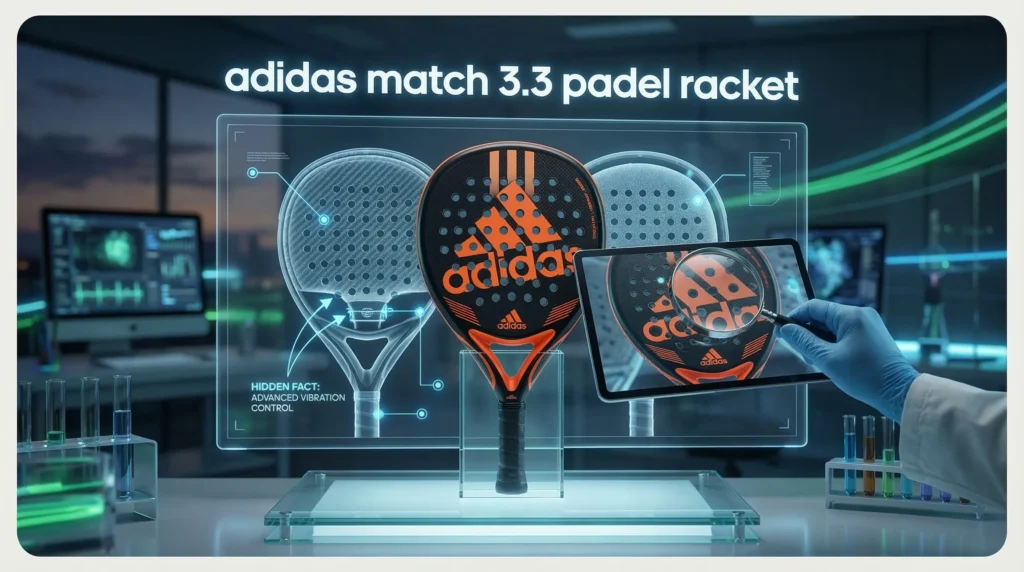
The Discovery Revolution: Why the adidas match 3.3 is Dominating UK Courts
The adidas match 3.3 padel racket isn’t just a beginner’s tool; it is an engineered entry point into the sport. While many big-box retailers focus on the “all-round” label, a deep adidas match 3.3 padel racket review reveals a sophisticated balance of power and forgiveness. Designed for players who are still defining their style, this racket employs a Teardrop (or hybrid) shape that strategically shifts the weight toward the upper part of the frame. This provides a slightly head-heavy balance (275mm), which is essential for generating power in overhead shots like the Bandeja without requiring the explosive wrist speed of a professional athlete.
- Core Composition: The heart of the racket features EVA Soft Performance rubber. This low-density polymer is designed for maximum Comfort and shock absorption, making it an excellent ally for players transitioning from tennis.
- Surface Material: Utilizing Fiber Glass (Fibre Glass) on both the face and frame ensures high elasticity. This creates a “trampoline effect” that aids ball exit speed even during slower swings.
- Structural Integrity: The 2024 model introduces Structural Reinforcement, a perimeter-based technology that resists high torsional stress during off-centre hits.
For those looking to safeguard their investment in the gravel-heavy sands of British courts, adding a padel racket protector is a non-negotiable step to prevent frame cracks during wall scrapes.
Expanding the Horizon: adidas Match 3.2 vs 3.3 vs 3.4
For the player with a passion for the details, choosing between generations of the Match series can be daunting. Let’s dissect the evolution of this line to understand where your money is best spent.
The Predecessor: adidas match 3.2 padel racket
The adidas match 3.2 padel racket was the cornerstone of the 2023 collection. It established the series as a leader in the discovery category. Compared to the current 3.3, the 3.2 focused heavily on a “pure control” philosophy. While it lacked some of the newer structural reinforcements, it remains a viable budget option for casual weekend players. However, it offers slightly less rigidity under pressure, meaning advanced beginners might find it “vibrates” more when facing faster, intermediate-level opponents.
The Current Standard: adidas match 3.3
This model is the “sweet spot” for 2024. It refined the Smart Holes Lineal technology—arranging holes in groups of three—to strengthen the surface area. This iteration is noticeably more durable than its predecessors, specifically designed to handle the “heavy” balls often encountered in the UK’s high-humidity environments.
The Future: adidas match 3.4 padel racket
The upcoming adidas match 3.4 padel racket (2025 range) marks a significant ergonomic shift. One of the biggest content gaps in current reviews is the handle length. The 3.4 addresses a common player complaint by subtly lengthening the grip. This change is revolutionary for players who prefer a two-handed backhand—a common trait for former tennis players in the UK. The 3.4 also features a slightly more refined weight distribution, making it feel even more nimble at the net during rapid volleys.
The “Black” Mystery: adidas match 3.3 black padel racket vs Standard Versions
Many players find themselves asking if the adidas match 3.3 black padel racket (often paired with Lime or Red accents) offers any technical advantage over the standard green or bronze models. The short answer is: technically, they are identical. However, from a performance-shaping perspective, the “Black” editions often appear in limited releases with specific cosmetic finishes that appeal to the aesthetic sensibilities of the modern player.
One “missing angle” often ignored is the Thermal Factor. In the rare event of a hot British summer day, black surfaces absorb more solar heat. This can subtly soften the EVA Soft Performance core even further, potentially increasing the ball output but slightly decreasing precision. If you are playing primarily in indoor centres like those managed by the LTA, this won’t be an issue. For those interested in professional-grade guidance, checking the official LTA Padel guide can provide further context on court conditions across the country.
Information Gaps: What Competitors Aren’t Telling You
Most reviews focus on the positives, but as a UK player, you need to know the challenges. Here are the “hidden” technical realities of the adidas match 3.3:
1. The Handle Length Dilemma
As mentioned, the 3.3 has a relatively short handle. If you have large hands or are used to a tennis-style grip, you may find it restrictive. To fix this, most expert players in the UK will apply an additional padel racket grip (overgrip) that extends slightly higher up the throat of the racket. This optimises the leverage during smashes.
2. Performance in the British Cold
Padel materials are “alive” to temperature. In temperatures below 10°C, the EVA Soft rubber hardens. This reduces the Sweet Spot size. If you play in unheated outdoor courts during winter, your Match 3.3 will feel “stiffer” and less forgiving. It is vital to store your racket at room temperature and avoid leaving it in the boot of your car overnight.
3. Smooth Surface vs Spin
Unlike the high-end Metalbone or Adipower series, the Match 3.3 has a smooth surface. It does not feature “Spin Blade” technology. Competitors often claim you can generate “great spin” with this racket, but technically, you will rely entirely on your technique rather than the racket’s texture. If you are desperate for spin and a lighter feel, you might consider the adidas drive light 3.4, which offers a different manoeuvrability profile.
Mechanical Bio-mechanics: Preventing the “Padel Elbow”
A major concern for the Discovery player is injury prevention. The adidas match 3.3 is mechanically designed to be “arm-friendly.” The combination of a Fiber Glass frame and EVA Soft core acts as a high-frequency vibration dampener. Unlike stiff carbon rackets which transmit the impact shock directly to the lateral epicondyle (the “tennis elbow” area), the Match 3.3 soaks up the energy of the ball impact. This makes it an ideal choice for recreational players who play 2-3 times a week and want to avoid the fatigue associated with stiffer, professional-grade gear.
Frequently Asked Questions (UK Edition)
Is the adidas match 3.3 suitable for a total beginner?
Absolutely. It is part of the “Discovery” range. Its large 520 cm² head size provides a generous sweet spot, making it very forgiving for those still learning to time their hits.
What is the main difference between the 3.3 and the Match Light version?
The standard 3.3 weighs between 360-375g. The “Light” version is significantly lighter (around 345-360g), making it easier to swing for those with less upper-body strength or those focusing purely on defensive manoeuvrability.
Can I use this racket in competitive league play in the UK?
Yes. While it is marketed for beginners, its Structural Reinforcement technology ensures it can handle the pace of competitive club play. Many intermediate players keep it as a reliable “control” racket in their bag.
How long does the Fiber Glass surface last?
Fiber Glass is more flexible but slightly less durable than carbon over several years. For an average player playing twice a week, you can expect 18-24 months of peak performance before the “springiness” of the fibre begins to diminish.
Does the adidas match 3.4 handle two-handed backhands better?
Yes, the 2025 Match 3.4 design acknowledges the trend of two-handed backhands in the UK and European markets, offering a slightly more ergonomic throat and handle area to accommodate the second hand.
Final Verdict: Should You Buy the adidas match 3.3?
The adidas match 3.3 padel racket remains the gold standard for players seeking Comfort, Durability, and Affordability. While the 3.4 offers interesting ergonomic updates for two-handed players, the 3.3 is currently the best value-for-money option on the market. Its ability to absorb vibrations and provide a consistent ball exit makes it a “safety net” for developing players.
To ensure your racket lasts through the British winters and the abrasive sands of local courts, remember to:
- Always use a frame protector.
- Keep your overgrip fresh to maintain traction in humid conditions.
- Never leave your racket in a cold car overnight.
Whether you are playing at a luxury indoor centre in London or a community court in Cardiff, the Match 3.3 provides the technical foundation you need to elevate your game from ‘Discovery’ to ‘Intermediate’ with confidence.