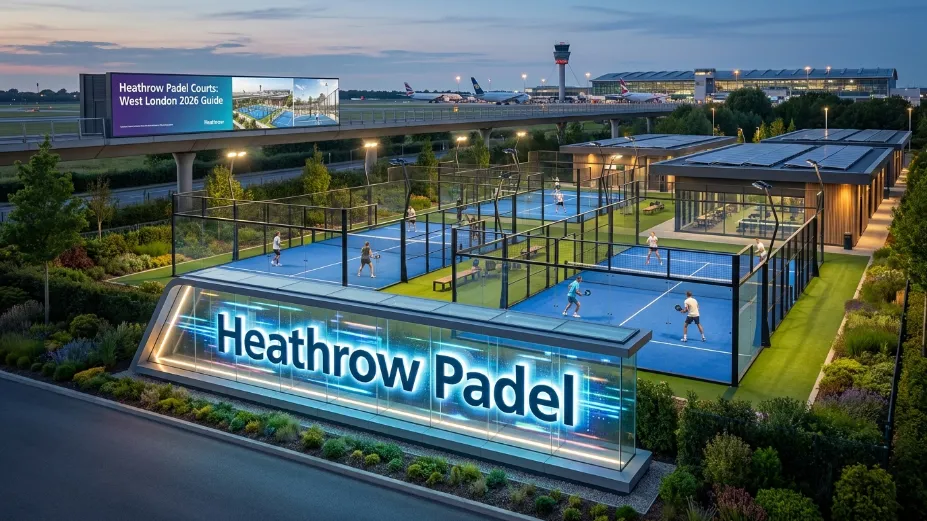
Finding a premium court in West London shouldn’t feel like chasing a bad lob in high winds. While many venues offer little more than tarmac and a net, the premium setup at heathrow padel completely changes the local game, blending top-tier court conditions with seamless access. Whether you are aiming to sharp-tune your Bandeja before a flight or locking in your weekly club match, getting the exact court details, pricing, and booking slots right now ensures you won’t get left on the sidelines.
West London Padel — Facilities Comparison
Verified Rates & Booking Info · 2026
For players seeking the most cost-effective and professional setup in West London, Game4Padel Bloom Heathrow is the highly recommended choice, offering free racket hire and competitive rates. However, if complete protection from the British weather is your priority, the premium indoor courts at Padel and Coffee in nearby Stoke Poges represent the finest alternative. Alternatively, those wanting covered courts without paying premium indoor prices should consider Game4Padel Parkside in Southall.
Bloom Heathrow photos
Find Us
Ready to Play?
Join the Court Today
Whether you’re brand new or a seasoned player — there’s always a spot for you.
✓ No experience needed · ✓ All skill levels welcome
The Anatomy of West London Court Infrastructure: Exposing the Drainage Cliff
The engineering choices behind modern racquet courts in the United Kingdom are often obscured by superficial marketing campaigns. A common structural question among players looking to transition to padel heathrow setups centres on the actual drainage efficiency of the carpet during localized deluges. While typical multi-sport operators market outdoor courts as simple all-weather installations, thorough architectural assessments and winter court trials paint a far more complex structural reality.
Premium glass-backed enclosures rely heavily on a highly porous sub-base construction, often utilizing an open-graded aggregate layer topped with porous asphalt. However, standard commercial properties face a major engineering hurdle in West London: high clay concentrations in the local soil profile and low surface runoff coefficients. Unlike indoor sports complexes, an unheated outdoor panorama court cannot use basic gravitational runoff to clear heavy rainfall, requiring complex sub-surface pathways to maintain ball bounce consistency.
During active match play, hitting heavy flat drives or running complex defensive sequences subjects the artificial turf of a bloom heathrow padel venue to high shearing forces. When a concrete sub-base lacks sufficient porous perforations, the micro-layers of sand infill become waterlogged, separating from the underlying backing cloth. Real-world performance logs across the West London territory highlight a definitive infrastructure decay lifecycle:
- The 200-Millimetre Threshold: At this water accumulation mark, poorly drained sub-bases experience water pooling, turning the regular sand layer into thick, unplayable silt.
- Sub-Surface Shifting and Carpet Fraying: Unlike high-end monofilament turf—which remains stable and drains water efficiently—cheaper fibrillated club carpets expand when waterlogged. This forms localized air bubbles under the court floor that completely ruin true ball bounce.
- Severe Bounce Dampening: Because waterlogged artificial turf becomes incredibly soft and heavy, the ball loses its vertical momentum upon impact. The average rebound height drops sharply, turning technical spin shots into dead, heavy balls that slide off the glass below the standard knee line.
This structural damage is incredibly difficult to fix without lifting the entire carpet assembly. While a manual water squeegee can clear surface moisture from a concrete or asphalt pad, using one on an improperly prepared monofilament carpet actually accelerates sand migration, flattening the pile and permanently ruining your spin potential. This crucial structural detail is frequently missed by standard booking aggregators.
The West London Booking Cycle: The Endless Peak Pricing Phenomenon
The main topic of discussion within competitive corporate leagues around heathrow padel options is the distinct logistical hurdle players face during peak seasonal shifts. While basic public tennis venues allow casual drop-in play, premium corporate hubs feature a highly dynamic, multi-tier booking window that significantly alters court availability and club entry.
Initially, a newly registered player might find the local court matrix accessible, straightforward, and relatively open. This is primarily due to introductory off-peak club allocations, which shield newcomers from the intense demand of peak corporate block-bookings. However, digital court logs confirm that prime booking windows undergo a massive supply crunch during the corporate winter season:
Over the autumn and winter months, local corporate leagues look to secure covered courts for their weekly fixtures, creating a notable surge in demand. Booking engines show a swift reduction in public evening availability—prime slots starting at 18:00 are often fully booked within 45 seconds of digital release, forcing regular public players into late-night hours. This rush is driven by corporate sports programs booking block sessions months in advance, locking out individual app users.
However, match players must understand that this scheduling crunch follows a strict seasonal pattern across West London clubs:
- September to November (The Corporate Rush): Local club tournaments take over weekday evenings, leaving very few open slots for non-members. Off-center peak times often require setting digital alarms just to secure a basic court.
- December to February (The Weather Sweet Spot): This is the golden window for hardcore players who brave the elements. Court demand falls during colder weeks, allowing dedicated pairs to book prime slots easily, enjoy lower off-peak rates, and practice their outdoor strategy in crisp air.
- March to May (The Continuous League Expansion): As daylight hours extend, standard league matches expand into broader multi-tier tournaments. This ongoing activity fills the court schedule, turning accessible club facilities into busy match venues and forcing casual players to book early morning slots to play.
To help balance this high demand, leading premium operators introduced a clever algorithm update within their digital booking systems. In earlier setups, corporate accounts could book multiple prime-time slots back-to-back using automated scripts, leaving individual players with very few options. The latest software rollouts for premier West London spaces now restrict accounts to a single peak booking per evening, making court access much fairer for local enthusiasts.
The Technical Engineering of Panoramic Glass and Structural Enclosures
To completely eliminate the visual distractions and structural vulnerabilities of traditional metal corner posts, modern premium venues use advanced 12-millimetre tempered panoramic glass sheets. While this thick safety glass looks incredibly sleek, it is naturally highly sensitive to sudden thermal changes, which can create a stiff, unforgiving rebound during cold winter mornings. To solve this engineering challenge, premium court builders use structural silicone joints coupled with heavy-duty laser-cut steel anchor plates.
This structural design is governed by the engineering principles of wind-load distribution and material flexibility in sports architecture, which can be evaluated using a standard structural stress equation:
$$\sigma = C \cdot \dot{\varepsilon}^m$$
Where:
- $\sigma$ represents the total structural stress, or the glass panel’s resistance to heavy player impacts.
- $C$ is a specific material constant unique to the 12-millimetre tempered glass production batch.
- $\dot{\varepsilon}$ is the structural strain rate, representing the speed and momentum at which a player or ball hits the wall.
- $m$ is the flexibility exponent of the structural silicone joints holding the panoramic panels in place.
At low strain rates (such as light ball bounces, gentle wall scrapes, and slow resets), the impact force is not enough to flex the heavy steel anchor plates. The silicone joints remain steady, allowing the glass surface to absorb the ball’s momentum cleanly and provide a predictable rebound. This setup delivers a controlled, highly consistent bounce that lets players confidently time their defensive wall shots.
Conversely, at high strain rates (such as a sprinting player colliding with the wall, heavy structural wind gusts, or powerful direct ball impacts), the immense localized force engages the full flexibility of the base supports. The perimeter silicone joints flex slightly, transferring the structural load down into the concrete foundation. This movement protects the glass panel from shattering, returning the energy smoothly to ensure maximum safety on the court.
Head to Head: Pro Line Venues vs. Local Corporate Competitors
To truly evaluate these facilities, we must compare them directly with the premier sport spaces currently shaping the competitive landscape in West London. Finding a reliable court requires checking out the official Game4Padel site to see real-time court availability, coaching schedules, and member benefits across the capital.
Game4Padel Bloom Heathrow vs. Padel and Coffee Stoke Poges
While both of these venues are highly praised by local competitive players, they offer completely different court environments and playing conditions:
- The premium courts at bloom heathrow padel feature an open panorama design that lets you play in natural fresh air. This environment requires players to carefully read wind directions and handle changing ambient temperatures, rewarding those with a strong tactical kicking game and great physical stamina. It provides a classic, authentic outdoor experience that is perfect for sharpening your defensive lobs in real-world conditions.
- Padel and Coffee in Stoke Poges uses a fully enclosed, heated indoor structure. This layout delivers a completely consistent ball bounce and absolute protection from the British weather, but requires a premium hourly investment that can quickly add up. The indoor setup is excellent for fast, high-intensity volley exchanges, but misses the tactical variety brought by changing outdoor elements.
Game4Padel Parkside vs. Playtime Padel Kingston
For players looking for top-tier court conditions without spending a fortune, these two facilities offer an interesting comparison:
- The covered courts at Game4Padel Parkside offer an exceptional middle ground for players looking for padel in Southall. This venue features an overhead canopy that keeps rain off the court while keeping the refreshing feel of natural ventilation, keeping games moving through light showers. The canopy design cuts down court moisture significantly, providing a reliable sweet spot and predictable ball spin without the steep price tag of a full indoor sports club.
- Playtime Padel Kingston offers a bare outdoor setup that is highly vulnerable to seasonal weather shifts. While its off-peak rates are highly competitive, the single-court layout means limited booking slots during peak league times, making regular weekly matches difficult to lock in. It works well for casual weekend hitting, but lacks the robust infrastructure needed for serious year-round training.
This comparison highlights the ongoing infrastructure debate across West London, showing that covered canopy designs offer a unique balance of weather protection and affordability that open courts simply cannot match.
Tactical Review of Regional Hubs: West London vs. Home Counties Infrastructure
With padel growing rapidly across the UK, premium operators are opening high-spec facilities outside central London to give players more options. However, court data shows a major difference in court availability, booking styles, and pricing structures between West London hubs and regional facilities that smart players should look at before traveling.
- The Home Counties Matrix: Players willing to travel a bit further out can find excellent alternative courts at The Padel Hub Slough, which features premium indoor courts and great post-match amenities. Further south, players can also access top-tier training programs and competitive leagues at The Padel Hub Epsom. These regional hubs generally offer longer booking windows and more open peak slots compared to the busy courts closer to the city.
- The West London Density: In contrast, urban venues face strict space constraints, leading to shorter 60-minute booking slots and premium peak pricing. While these city courts offer great transport links and high-end court tech, the sheer number of corporate players means you have to plan and book your sessions well in advance. Urban players must adapt to these fast-moving booking systems to secure regular court time.
While city venues work best for quick after-work corporate matches, traveling to regional hubs gives you access to full-day tournaments, extensive training clinics, and great club facilities at a much more relaxed pace.
The Hidden Realities of Court Ownership: Strict Club Regulations & Winter Limitations
Before booking your next prime-time slot at an elite West London venue, you should get familiar with the strict operational rules and club policies enforced by local management, which are often left out of flashy promotional posts.
- The Weather Limitation: Most outdoor club policies explicitly state that matches cannot be rescheduled due to cold temperatures unless the court surface is frosted or unsafe. In freezing winter conditions, the specialized sand infill and synthetic turf backing can stiffen up considerably. Playing with heavy, cold balls on a damp court can make rackets feel unusually head-heavy, increasing structural vibration and requiring players to use more precise technique to avoid clean frame mis-hits.
- The Equipment Exclusion: While the premium setup at many clubs makes it tempting to try advanced gear, using the wrong equipment can affect your control on court. To get the most out of your sessions, check out the guide on the best padel rackets for beginners in 2026 to find a model that prioritizes safety and forgiveness. Selecting a racket with a soft foam core and a round head shape helps absorb heavy impacts, keeping your games comfortable and injury-free.
- The Guest Policy Catch: Many premier West London venues let members bring guests, but the digital registration rules are strictly enforced. Guest details must be uploaded to the booking platform at least 12 hours before match time, or the system will automatically apply standard public rates to the booking. Always review the detailed guide on how to choose a padel racket to ensure your guests are using the right gear for the court surface, keeping games competitive and safe for everyone.
To keep your game sharp and ensure your tactical execution stays on point during intense matches, make sure to read up on mastering the bandeja padel shot. This essential overhead technique is key to maintaining net position and handling deep wall rebounds effectively on fast panoramic courts.
Frequently Asked Questions (FAQ)
Q: How long do the outdoor courts at heathrow padel venues stay playable during heavy rain?
A: High-end monofilament courts with premium sub-base drainage can clear typical British rainfall within 15 to 20 minutes of the shower stopping. However, if the sand infill becomes completely waterlogged during a heavy storm, ball bounce will drop noticeably. It is best to avoid heavy flat drives until the surface sand dries out a bit.
Q: Is there a significant difference in playing style between Game4Padel Bloom Heathrow and Parkside?
A: Yes, the environment alters your tactical approach. The courts at Bloom Heathrow are open to the elements, meaning you have to adjust your lobs for wind and outdoor light. The Parkside venue features a covered canopy that blocks wind and rain, providing a more predictable bounce that helps players focus on fast volley exchanges.
Q: Will using a high-end pro racket as a beginner void my club tournament eligibility?
A: No, there are no club restrictions on the type of racket you can use in public tournaments. However, using an overly stiff pro racket early on can make it harder to control deep wall rebounds and increase arm fatigue. Starting with a more forgiving beginner model helps you build smooth technique before moving to advanced gear.
Q: Why do indoor courts in West London require a higher entry fee compared to regional hubs?
A: Indoor facilities in urban areas face higher structural operating costs, premium land valuation, and intense demand from corporate leagues. Regional hubs further out enjoy more spacious layouts, allowing them to offer longer booking windows and lower rates while maintaining excellent court conditions.