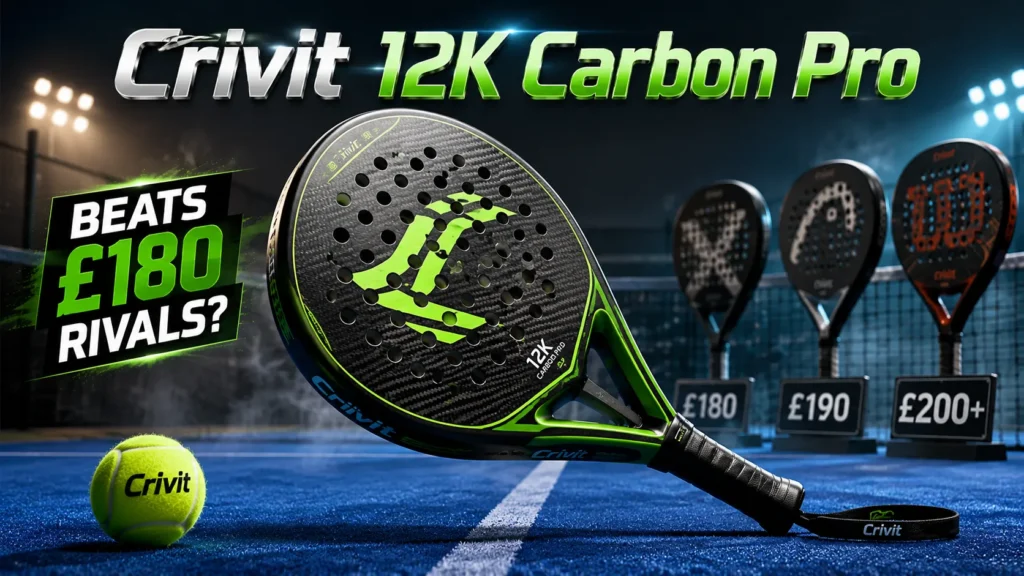
Lidl’s release of the Crivit 12K Carbon Pro has quietly triggered a structural shift across UK padel clubs, leaving player-brand loyalists questioning the steep price tags of their premium frames. Engineered with a dense 12K carbon fibre weave, an uncompromising high-density EVA core, and full LTA tournament-legal compliance, this frame brings raw, uncompromising performance to the sub-£60 price bracket.
Whether you are battling damp outdoor conditions in Manchester or trading rapid net volleys in London, the Crivit 12K Carbon Pro delivers the structural rigidity and aggressive overhead power typically reserved for elite-tier equipment. Here is how it truly performs under real British playing conditions.
Crivit 12K Carbon Pro vs Premium
Technical specification comparison · UK Market
Short Answer: The Crivit 12K Carbon Pro represents an unprecedented value proposition in the UK market, delivering intermediate to advanced players structural stiffness, structural integrity, and active power comparable to premium £180+ racquets at a fraction of the price (£59.99). While its high-density core demands active swing technique on cold, damp outdoor courts, its 100% LTA tournament-legal dimensions and robust construction make it the undisputed leader in the budget performance category across British padel clubs.
Crivit 12k carbon pro review: Anatomical Breakdown and Core Performance
Performing a comprehensive Crivit 12k carbon pro review requires looking far beyond marketing headlines and inspecting the structural anatomy of the racquet. At its core, the racquet utilizes a 12K carbon fibre weave across the striking faces—meaning 12,000 micro-filaments of carbon are woven into each tow. This dense composite matrix produces high surface rigidity compared to standard 3K carbon or flexible fibreglass models. When struck cleanly in the sweet spot, energy transfer is direct and immediate, yielding exceptional ball velocity on aggressive overhead strikes such as the por tres or flat smash.
Inside the frame, Lidl has incorporated a Black High-Density EVA Foam core. Unlike softer white EVA variants that absorb impact energy to generate a “trampoline effect”, this high-density core acts as a stiff wall. It requires the player to supply their own active arm acceleration to drive the ball deep into the opposition court. Surrounding the foam core is the 12K Carbon Tube System, reinforced at the throat by the Power Core Bridge. This bridge design prevents lateral torsional twisting when catching off-centre shots, conferring remarkable frame stability during fast-paced volley exchanges at the net. Players exploring carbon fibre padel rackets will immediately recognise the firm, tactile feedback characteristic of high-spec carbon frames.
For those evaluating how to choose a padel racket, understanding the balance profile of the Crivit 12K Carbon Pro is vital. Despite its aggressive teardrop profile, the weight distribution sits neatly at a 27 cm balance point. This neutral weighting ensures that the 370g overall mass does not feel overly head-heavy, allowing players to manoeuvre the racquet quickly during defensive wall rebounds and rapid reflex volleys.
Crivit 12k carbon pro test: On-Court Kinematics in UK Weather Conditions
Executing a rigorous Crivit 12k carbon pro test on UK soil presents unique challenges that sun-drenched Mediterranean reviews completely miss. Outdoor courts in London, Manchester, and Bristol frequently feature ambient temperatures dropping below 10°C alongside high atmospheric humidity. Cold weather causes high-density EVA foam cores to contract and harden further, while wet padel balls absorb moisture, gaining weight and losing natural bounce.
Under these real-world British playing conditions, the Crivit 12K Carbon Pro exhibits distinctive kinematic behavior. On cold outdoor courts, the combination of a hardened Black EVA core and dense 12K carbon face creates an extremely firm hitting surface. Defensive play from the back glass requires complete follow-through strokes; half-swings or passive block shots will leave heavy, wet balls dropping short into the transition zone. However, when attacking at the net, this structural firmness becomes a major advantage. The frame resists ball distortion, allowing aggressive players to punch volleys through heavy, damp air with remarkable directional accuracy.
Compared to softer models in the Lidl padel racket range, the 12K Carbon Pro demands sound technical execution. Players accustomed to the automatic rebound of flexible fibreglass frames must adjust their timing, ensuring clean contact in the central sweet spot to avoid harsh feedback. When evaluating options among the best budget padel rackets, few entry-level frames offer this degree of structural resistance against heavy wet ball impact.
Head to Head: Crivit 12K Carbon Pro vs Market Rivals
To truly grasp the disruptive nature of this release, a direct head-to-head comparison against competing market tiers is essential. The market can be divided into entry-level store models, mid-range traditional brand offerings, and elite tour-level racquets.
- Head to Head vs Basic Supermarket Racquets (£12.49 – £29.99): Entry-level store options (such as basic Crivit or Aldi fibreglass models) utilize soft fibreglass faces and low-density foam cores. While forgiving for absolute beginners, these frames flex excessively under heavy hitting and often suffer from dimensional non-compliance. In contrast, the Crivit 12K Carbon Pro provides high structural stiffness, a full carbon frame, and strict adherence to LTA regulation dimensions, making it a true performance instrument rather than a recreational toy.
- Head to Head vs Mid-Range Brand Racquets (£80.00 – £120.00): Mid-range models like the Babolat Vertuo series or entry-level Slazenger padel racket options often feature flexible carbon-glass hybrid faces. While these offer a larger sweet spot and easier ball output, the Crivit 12K Carbon Pro surpasses them in pure overhead power potential due to its rigid 12K carbon surface and solid Power Core Bridge.
- Head to Head vs Elite Tour Racquets (£180.00 – £280.00): Premium carbon racquets such as the Adidas Metalbone or Bullpadel Vertex feature advanced 3D surface textures, customizable weight systems, and multi-density EVA cores. While elite racquets offer superior spin generation and refined vibration dampening, the Crivit 12K Carbon Pro matches roughly 80–85% of their raw structural performance at under a third of the retail price.
Detailed analysis in Lidl vs premium padel rackets comparisons shows that while top-tier brand racquets excel in finish refinement, the core structural engineering of the Crivit 12K Carbon Pro stands head and shoulders above anything else in the sub-£60 price bracket.
Crivit 12k carbon pro price, Value & Total Cost of Ownership (TCO)
Evaluating the Crivit 12k carbon pro price of £59.99 requires examining the Total Cost of Ownership (TCO) over an extended playing period. Many budget racquets constructed from cheap fibreglass composites experience core softening within 3 to 4 months of regular play (twice weekly), leading to dead spots and premature frame replacement.
By contrast, the 12K Carbon Tube System and high-density EVA core of the Crivit 12K Carbon Pro maintain structural integrity over 12 to 18 months of intensive club play. Taking into account the £59.99 initial investment, the effective cost per match over a 12-month period (playing twice weekly, roughly 100 matches) drops to approximately £0.60 per match. Compare this to a £240 premium racquet replaced annually (£2.40 per match), and the financial advantage becomes overwhelming.
Furthermore, Lidl UK backs the product with a 3-year manufacturer warranty covering structural manufacturing defects. This warranty protection provides immense peace of mind for club players who worry about premature frame fracture along the bumper or throat. Direct comparisons in Lidl vs Slazenger comparison reviews highlight that this combination of 12K carbon construction and extended warranty coverage sets a new benchmark for consumer protection in the UK padel market.
Engineering Breakdown: 12K Weave, High-Density EVA & Structural Frame
The mechanical efficiency of a padel racquet depends on how effectively it manages kinetic energy during impact. The 12K carbon weave utilized on the Crivit Pro features flat, wide carbon bands woven in a tight grid pattern. This construction minimizes resin accumulation between fibres, keeping overall frame weight low while maximizing tensile strength.
When striking the ball flat, the rigid 12K face undergoes minimal deformation. Rather than storing energy elastically, it reflects the impact force directly back into the ball. The Power Core Bridge across the throat distributes kinetic stress evenly into the outer frame tubes, reducing structural twist. Players can review full technical specifications directly on the official product portal via Official Crivit 12K Carbon Pro Specs.
Ergonomics, Handle Modifications, and Strain Reduction
While the structural frame of the Crivit 12K Carbon Pro receives top marks for rigidity, the stock handle configuration warrants careful attention from UK players. Out of the factory, the racquet features a relatively slim base grip profile. Holding a thin grip too tightly forces players to squeeze excessively with forearm muscles, which can lead to rapid hand fatigue and joint discomfort during extended matches.
To optimize ergonomics and reduce vibration transmission on cold outdoor courts, applying one or two quality overgrips is highly recommended. Increasing handle circumference allows for a more relaxed grip pressure, improving wrist snap on overheads while dampening high-frequency shock waves before they travel up the arm. Exploring options among specialized padel racket grips is an essential step for custom fitting the handle. Players prone to arm stress should also consult resources on best padel rackets for tennis elbow to understand how grip thickness and vibration dampening interplay during play.
LTA and FIP Legal Compliance for UK Club Play
A critical missing angle in basic racquet reviews is regulatory compliance. To compete in official UK club leagues, sanctioned tournaments, or LTA-rated events, a racquet must strictly conform to International Padel Federation (FIP) dimensional standards:
- Maximum Length: 45.5 cm
- Maximum Width: 25.5 cm
- Maximum Thickness: 3.8 cm
While basic £12.49 supermarket store racquets often feature oversized dimensions (e.g., 46.5 cm length) that render them strictly illegal for competitive play, the Crivit 12K Carbon Pro measures precisely 45.5 cm x 25.5 cm x 3.8 cm. It is 100% tournament legal across all LTA-sanctioned events in Great Britain. Players competing in LTA padel tournaments can step onto the court with full confidence that their equipment meets every regulatory standard.
Frequently Asked Questions
1. Is the Crivit 12K Carbon Pro legal for official LTA league matches in the UK?
Yes, absolutely. Unlike lower-tier supermarket racquets that exceed official dimensional limits, the Crivit 12K Carbon Pro adheres strictly to the FIP and LTA regulation size of 45.5 cm in length, 25.5 cm in width, and 3.8 cm in depth. It is fully approved for all official UK league and tournament play.
2. How does damp British weather affect ball exit speed on this 12K carbon face?
In cold, damp conditions (under 10°C), the Black High-Density EVA core and 12K carbon face harden further, eliminating passive trampoline rebound. Players must generate active arm speed and hit cleanly in the sweet spot to drive heavy wet balls deep into the court.
3. Why does active power in a 12K frame feel firmer than beginner fibreglass models?
Fibreglass faces flex upon ball contact, storing and releasing energy like a trampoline. High-density 12K carbon does not flex easily; instead, it transfers the player’s swing energy directly into the ball. This offers higher maximum smash speed and precision control, but requires good hitting technique.
4. Should I add an overgrip to the stock handle of the Crivit 12K Carbon Pro?
Yes, adding at least one overgrip is highly recommended. The factory grip is relatively thin for average British adult hands. Expanding the grip size improves hold comfort, prevents over-squeezing, and dampens high-frequency impact vibrations during play.
5. Can you generate heavy slice and topspin without a 3D textured surface?
While the smooth matte finish lacks 3D ridges or sandblasted grit, the stiffness of the 12K carbon face provides clean, predictable ball contact. Generating heavy slice or topspin relies on striking the ball with a sharp brush angle and maintaining fast head speed through impact.
Strategic Buying Advice & Final Verdict
The Crivit 12K Carbon Pro is a game-changing entry into the UK padel market. By offering authentic 12K carbon face construction, a rigid Power Core Bridge, high-density Black EVA foam, and full LTA tournament compliance for £59.99, Lidl has disrupted the traditional pricing structure of padel equipment.
Who Should Buy It: Intermediate to advanced players seeking high structural rigidity, aggressive smash power, and solid net volley control on a budget. It is an outstanding choice for club players wanting premium carbon performance without spending £180+.
Who Should Avoid It: Complete beginners who benefit more from soft, forgiving fibreglass frames with high trampoline bounce, or players with severe joint sensitivities who require soft, low-density foam cores. For intermediate attackers in the UK, however, the Crivit 12K Carbon Pro stands as the undisputed value champion of 2026.