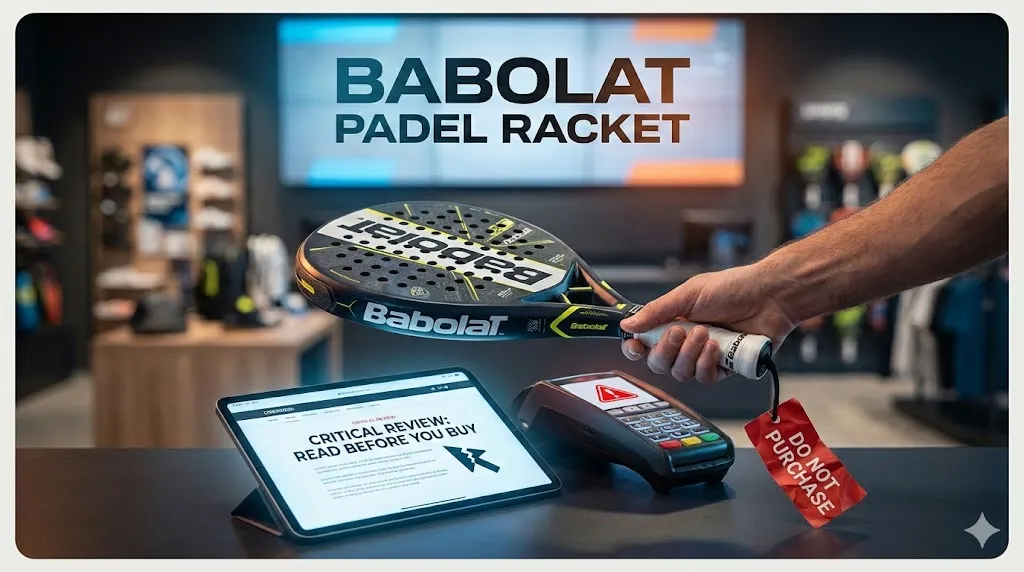
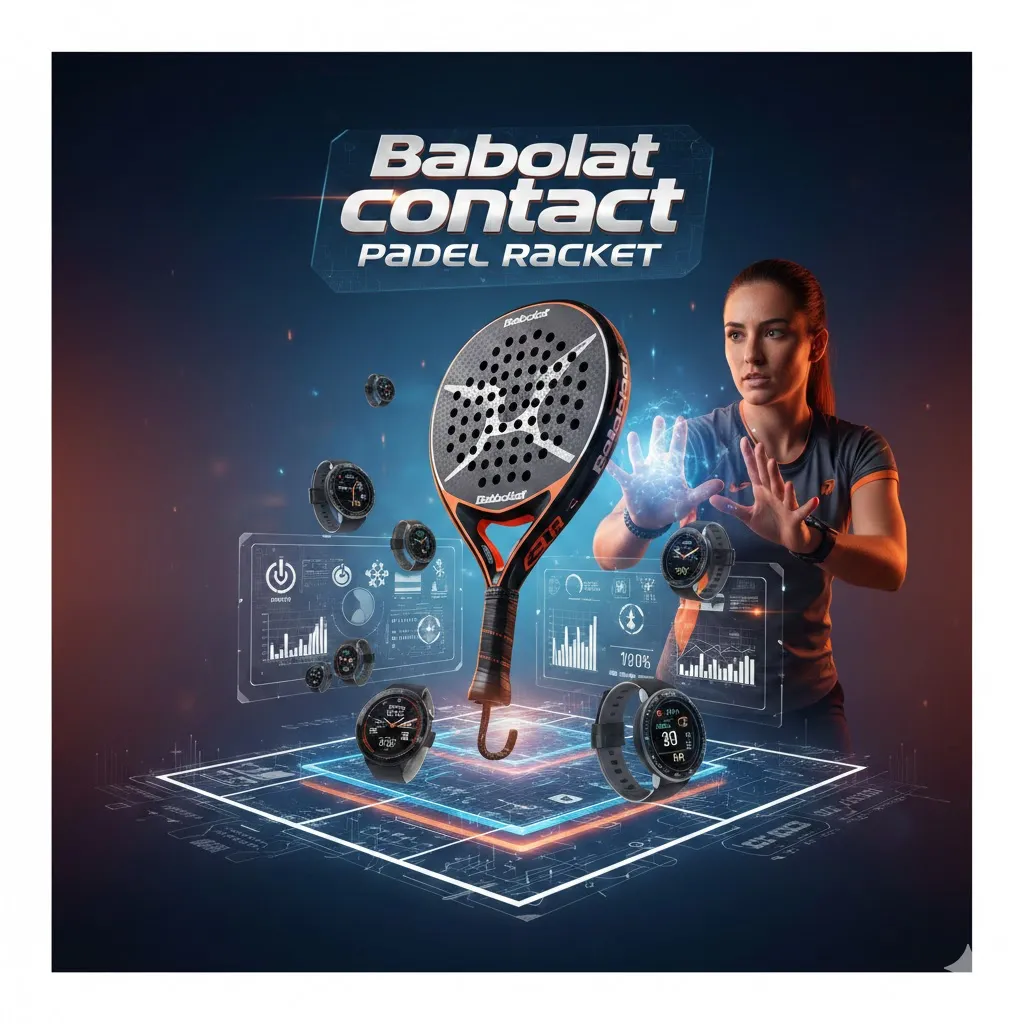
Most players dismiss the babolat contact padel racket as merely a “starter” frame—a temporary tool to be discarded the moment they learn to hit a decent bandeja. This is a fundamental misunderstanding of the racket’s engineering. While it is positioned at an accessible price point, the physics governing its playstyle are sophisticated. It isn’t just a cheap padel racket; it is a meticulously designed instrument of “easy power” and high forgiveness. By utilizing a specific combination of Soft Fiber technology and low-density EVA Soft foam, Babolat has created a racket that dictates a very specific style of play.
In this technical deep-dive, we move beyond the marketing fluff to analyze how the material science of the Contact affects energy transfer, swing mechanics, and long-term durability on the court.
The Physics of Softness – Fiber and Foam Dynamics
The core of the Babolat Contact’s identity lies in its “Soft Fiber” technology and the density of its EVA core. Unlike the rigid, high-modulus carbon fiber found in professional-grade rackets like the Technical Viper, the Contact utilizes a specific weave of fiberglass. This material choice is not merely a cost-saving measure; it is a tactical decision based on the physics of energy return.
The “Trampoline Effect” and Low Swing Speeds
For a beginner or intermediate player, the ability to generate ball speed is often limited by a shorter swing path and less-developed forearm strength. The babolat padel racket contact addresses this through the “trampoline effect.” When the ball strikes the fiberglass face, the material undergoes a greater degree of elastic deformation than carbon. This deformation stores potential energy, which is then released back into the ball as it leaves the face. In technical terms, the lower Young’s Modulus of fiberglass allows for a higher coefficient of restitution at lower impact velocities. This means a player can achieve “easy power” without needing the explosive swing speed required to “activate” a stiffer carbon frame.
Fiberglass Flex Dynamics and Elastic Limits
While premium rackets utilize 100% carbon frames, the babolat contact 2026 padel racket employs a sophisticated Carbon Composite frame. This hybrid construction integrates carbon fibers into the frame’s structure for rigidity and impact resistance, while maintaining a 100% fiberglass face (Soft Fiber). This specific ‘material split’ ensures the racket remains flexible enough for beginners to find power, yet durable enough to withstand the high-stress environment of modern padel.
Micro-Vibration Analysis
One of the most critical aspects of the Babolat Contact is its vibration dampening. Off-center hits are common when learning the game. These hits generate high-frequency vibrations that travel through the frame into the handle. The integrated Soft Fiber technology acts as a mechanical filter. By using a more compliant resin and fiber matrix, the racket absorbs these high-frequency peaks, converting kinetic energy into negligible thermal energy. This reduces the mechanical stress on the player’s elbow and wrist, allowing for longer training sessions without the fatigue associated with stiffer, more “vibrant” rackets.
Mastering the Learning Curve – Mechanics and Transition
The transition from tennis to padel is often fraught with technical errors, and the babolat contact padel racket is specifically engineered to mitigate these. At a weight of approximately 345 grams, it is significantly lighter than a standard tennis racket (which often exceeds 300g without the added mass of the padel racket’s solid core).
The “Wristy” Shot Trap
A common pitfall for new players is using too much wrist, a habit often exacerbated by a light racket. Because the Babolat Contact is so maneuverable, there is a temptation to “flick” the ball. However, the oversized round head provides a massive sweet spot that encourages a “pushing” motion rather than a “hitting” motion. The physics of the oversized geometry increases the moment of inertia on off-center hits, meaning the racket is less likely to twist in the hand. This stability helps the player trust their stroke, eventually leading to the development of the “compact” padel swing where the power comes from the legs and core rather than the wrist.
Defensive Precision and the Lob
In padel, the lob is an offensive weapon disguised as a defensive one. The Babolat Contact features a balance point that leans slightly toward the head to compensate for its overall lightness. When a ball is taken low off the glass, this balance helps the racket “plow through” the air, providing the necessary mass to lift the ball deep into the opponent’s court. The “Soft” EVA core provides a longer dwell time (the duration the ball stays on the strings), which is crucial for the “feel” required to place a lob accurately.
Structural Integrity and Environmental Resilience
Durability is a major concern for players investing in their first racket. The babolat contact 2026 padel racket (and its predecessors) is built to withstand the unique rigors of the padel court, including the inevitable “glass-clash.”
The “Wall Test” and Frame Reinforcement
The 2026 iteration of the Contact features enhanced structural integrity. By transitioning to a Carbon Composite layup in the frame’s perimeter, Babolat has addressed the fragility often associated with entry-level fiberglass rackets. This composite blend is significantly more ductile than pure carbon, allowing the frame to absorb the energy of a ‘glass-clash’ at the 10 and 2 o’clock positions without the risk of micro-fractures, making it a truly resilient choice for players still mastering their spatial awareness..
Humidity and EVA Degradation
The “Soft” EVA core is sensitive to environmental factors. In high-humidity environments, the foam can absorb microscopic amounts of moisture, or more commonly, the heat can soften the polymer chains within the foam. Over a 6-month period of heavy use, a player might notice the racket feeling “mushy.” This is the point where directional control begins to suffer. However, because the Contact is designed as a transitional racket, most players will have developed the skills to move to a more durable “Carbon” line by the time the EVA core reaches the end of its optimal lifecycle.
The Exhaustive Review of the Babolat Contact Padel Racket
When we look at the babolat contact padel racket as a whole, it stands out as the ultimate “enabler.” It does not demand perfection; instead, it rewards participation.
Performance Breakdown:
- Maneuverability: Rated 10/10 for beginners. The 345g weight makes it feel like an extension of the arm, allowing for rapid-fire volleys at the net.
- Control: The oversized round head ensures that even if you don’t hit the “dead center,” the ball still goes over the net. It is a “low-consequence” racket.
- Power: While it lacks the “smash power” of a diamond-shaped racket, its elastic face provides enough depth for 90% of beginner-to-intermediate play.
The babolat padel racket contact is often updated annually with new liveries, but the core DNA remains the same: accessibility. Whether you are looking at the current model or anticipating the babolat contact 2026 padel racket, the focus remains on a large sweet spot and a weight that prevents injury while maximizing fun. It is the gold standard for those who want to learn the “right way” without the frustration of a demanding, professional-spec racket.
Frequently Asked Questions
1. How does the Babolat Contact’s EVA Soft core interact with the fiberglass face to create a “trampoline effect”?
The “trampoline effect” is a result of the low density of the EVA Soft core combined with the high elasticity of the fiberglass face. When the ball hits the racket, both the face and the core compress significantly. Because fiberglass is more flexible than carbon, it stretches further, storing more elastic energy. As the ball leaves the face, the core and face “snap back” to their original shape, catapulting the ball forward. This is ideal for players with slower swing speeds who need help getting the ball to the back of the court.
2. At what point does the fiberglass surface reach its “elastic limit” during high-impact overheads?
The elastic limit is reached when the force of the impact is so great that the fiberglass can no longer deform linearly. In practical terms, this happens during very hard smashes. You will notice that no matter how much harder you hit, the ball doesn’t go much faster. This “plateau” usually occurs once a player reaches an intermediate-plus level of physical strength, signaling it is time to move to a carbon-faced racket.
3. How does the oversized geometry affect aerodynamic drag during quick transitions?
The oversized round head increases the surface area, which naturally increases aerodynamic drag (air resistance). While the racket is light (345g), the “swing weight” can feel slightly higher than a smaller-headed racket during fast net exchanges. However, for beginners, the benefit of the larger sweet spot far outweighs the millisecond of drag lost during a transition from defense to volley.
4. How does the “Soft Fiber” technology dampen vibrations on off-center hits?
Soft Fiber technology utilizes a more flexible resin matrix to bond the fiberglass layers. When a ball is struck off-center, it creates a “twisting” vibration. The flexible nature of the Soft Fiber absorbs these shear forces, preventing the high-frequency “sting” from traveling down the frame. This makes the Babolat Contact one of the most comfortable rackets for players prone to joint sensitivity.
5. Does the extreme lightness (345g) encourage “wristy” technique?
Yes, there is a risk. Because the racket is so easy to move, beginners often use their wrists to “flick” the ball rather than using their whole body. Coaches recommend focusing on keeping the wrist firm and using a short, controlled backswing to counteract this tendency. The racket is a tool for learning, but it requires the player to be mindful of proper mechanics.
6. How does the high balance point affect defensive lob precision?
Lighter rackets often have a “head-heavy” balance to provide some stability. In the Babolat Contact, this helps when you are digging out a low ball near the glass. The weight at the top of the racket provides a bit of momentum, helping you “swing through” the ball to get the height and depth required for a successful defensive lob.
7. Is there a “Dead Zone” near the bridge of the racket?
While the sweet spot is oversized, the area near the bridge (the throat) is significantly stiffer than the center. Strikes in the lower third of the face will experience a significant drop-off in energy transfer because the frame is more rigid there. However, compared to a diamond-shaped racket, the Babolat Contact’s “dead zone” is much smaller and more forgiving.
8. At what ball velocity does the racket’s lack of mass become a liability?
When facing high-velocity shots like a “Bajada” or a pro-level smash, the 345g mass of the Contact may lack the stability to “block” the ball effectively. The racket may twist in your hand because it doesn’t have enough inertia to resist the ball’s force. This usually becomes an issue once you start playing against Level 4.0+ players.
9. How does high humidity affect the EVA Soft core over 6 months?
High humidity can cause the internal cells of the EVA foam to lose their “rebound” quality. Over time, the racket may feel “dead” or “mushy,” losing its crispness. If you play in coastal or tropical climates, it is essential to keep the racket in a thermal-lined bag to extend its lifespan.
10. How is the frame reinforced for “Glass-Clashes”?
Babolat uses a “Protector” strip on the head and a specific layup of fiberglass around the rim (the 10 and 2 o’clock positions). This makes the frame more impact-resistant than pure carbon frames, which are more susceptible to cracking when they hit the hard walls of the padel court.
11. How does adding two overgrips shift the balance point?
Adding two overgrips adds about 10-15 grams to the handle. This shifts the balance point toward the hand (making it more “head-light”). While this increases maneuverability even further, it can slightly reduce the “easy power” provided by the original head-heavy balance. Most players find this a fair trade-off for a better grip.
12. What swing path adjustments are needed for spin on a smooth surface?
Since the Babolat Contact has a smooth surface, you cannot rely on the racket “gripping” the ball. To generate slice on a *Bandeja*, you need a more aggressive “high-to-low” swing path and a faster racket-head speed. You are relying on “friction through contact duration” rather than “mechanical grip” from a rough surface.
13. Does the “Head Light” feel improve reflex volleys?
Actually, the Babolat Contact is slightly head-heavy for its weight class, but because it is so light overall, it feels very fast. This helps with “reflex volleys” at the net, though you must ensure you meet the ball in front of your body to prevent the racket from twisting due to the lack of heavy mass.
14. How does the weight distribution assist in the “Glass-to-Net” transition?
The light weight allows you to reset your racket position quickly as you run forward. In the “transition zone,” where you often have to hit a “half-volley,” the Babolat Contact’s maneuverability allows you to get the racket head down quickly, making the move from defense to offense much smoother for less-experienced players.