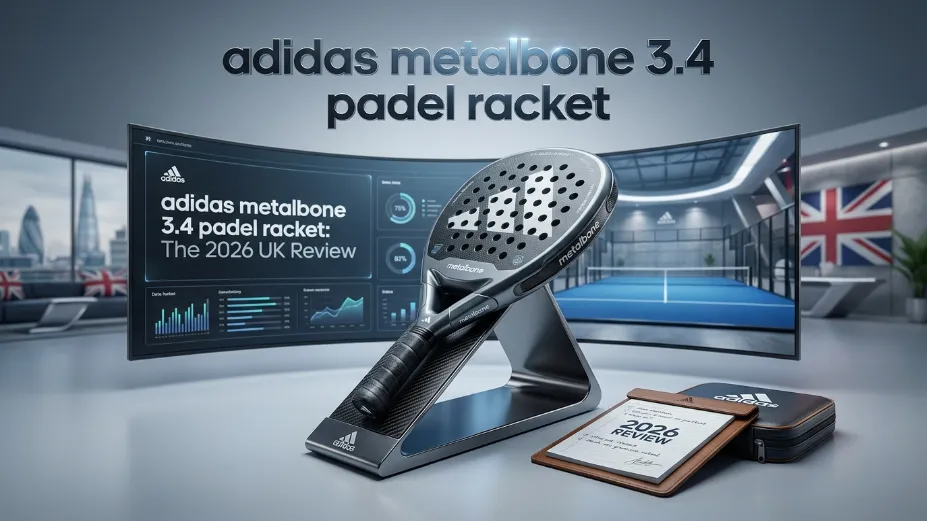
The era of choosing between raw power and surgical precision has officially ended. When Ale Galán steps onto the court, his weapon of choice isn’t just a piece of sports equipment; it is a masterclass in carbon engineering. The adidas metalbone 3.4 padel racket has arrived to redefine the 2025 season, offering a bespoke customisation level that makes previous iterations feel like mere prototypes.
If you are serious about dominating the transition from the back of the court to the net, understanding the nuanced physics behind this frame is no longer optional—it is essential.
Adidas Metalbone 3.4 Series
Verified Technical Specs & 2026 Market Rates
Direct Recommendation: For players in the United Kingdom looking for the best all-court performance at a competitive price, the adidas metalbone carbon 3.4 padel racket is the superior choice for high-level intermediates, while the flagship 3.4 Standard is recommended for professional-grade attackers seeking maximum lever-based power. If you are training at padel courts indoor london cheapest rates, the Carbon CTRL variant offers the best durability-to-cost ratio for frequent sessions.
The 16K vs 6K Dichotomy: Decoding the Adidas Carbon Matrix
One of the most significant “information gaps” in the current padel market is the misunderstanding of carbon density. While many brands follow a linear “higher K equals stiffer” logic, Adidas utilises a more sophisticated approach. The 16K Aluminised Carbon found on the flagship 3.4 models is actually more elastic and flexible than the 6K Carbon used in the adidas metalbone carbon 3.4 padel racket.
- Aluminised 16K Carbon: Designed for professional-level “memory,” this surface allows the ball to sink slightly deeper into the face before rebounding with explosive speed. This creates a larger sweet spot, which is vital for the best padel rackets for advanced players.
- 6K Carbon: This material provides a “drier,” stiffer sensation. It is less forgiving on off-centre hits but offers a very direct feedback loop. Players using the adidas metalbone carbon ctrl 3.4 padel racket often report that they feel more “connected” to the ball during tactical volleys.
In the cooler, damp conditions often found at outdoor UK clubs like Padel Tunbridge Wells, the choice of carbon density significantly impacts ball output. Stiffer 6K frames can feel “glassy” in cold weather, whereas the 16K Aluminised face maintains its elastic properties, ensuring your lobs don’t fall short at Padel Torquay or other coastal venues.
Structural Geometry: Octagonal Rigidity and the 13cm Lever
The 2025/2026 series introduces a refinement of the Octagonal Structure. By using an eight-edged carbon tube, Adidas has successfully increased torsional rigidity—the racquet’s ability to resist twisting. This is particularly noticeable on the adidas metalbone ctrl 3.4 2025 padel racket, where the round shape usually sacrifices some frame stability for control. The Octagonal framework ensures that even if you miss the sweet spot, the energy transfer remains linear.
The Power Extra Grip: A Game Changer for Tennis Converts
Perhaps the most critical upgrade from the 3.3 to the 3.4 is the 13cm handle. Traditional padel racquets often feature handles between 11cm and 12cm, which can feel cramped for UK players transitioning from tennis. This 2cm extension, known as the Power Extra Grip, serves two purposes:
- Two-Handed Backhand Support: It finally provides enough real estate for a comfortable two-handed grip, common among British LTA-trained players.
- The Lever Effect: By lengthening the distance between the hand and the head, the 3.4 generates more inertia. This results in heavier smashes, making it one of the most powerful adidas padel racket ale galan options on the market.
Head to Head: Metalbone 3.4 Standard vs. Metalbone Carbon 3.4
When deciding between the flagship and the carbon series, the choice boils down to customisation vs. consistency. The adidas metalbone 3.4 padel racket features the Weight & Balance System, now relocated to the top and sides of the frame for 2025. This allows you to remove up to 12g, shifting the balance by up to 1.5cm towards the head. If you find yourself playing a tournament at The Padel Hub Reading, you can adjust your racquet based on whether the court is fast (indoor) or slow (outdoor).
Conversely, the adidas metalbone carbon 3.4 padel racket lacks this weight system. While some might see this as a downgrade, many advanced players prefer the fixed balance for its reliability. There are no screws to lose, and the 6K carbon face provides a stiffer, more traditional “pro” feel. If you are learning padel serve tips and want a racquet that behaves exactly the same way every time, the Carbon series is arguably more logical.
Addressing the Missing Angles: The Arm Pain Paradox
A “missing angle” often overlooked by mainstream reviewers is the incidence of arm discomfort despite the EVA Soft Performance core. On forums like Reddit, some UK players have noted shoulder strain when switching to the 3.4 series. This is rarely due to the foam hardness; instead, it is a byproduct of the 13cm handle. The longer lever increases the torque on the wrist and forearm if your timing is slightly off.
If you have a history of injury, we recommend checking our guide on the best padel rackets for tennis elbow or adding an extra overgrip to increase the handle circumference, which reduces the need to “choke” the racquet too tightly. For more information on UK injury prevention, visit the LTA Padel Guide (Open in new tab).
Specific Keyword Deep Dive: The CTRL Variations
The adidas metalbone ctrl 3.4 2025 padel racket is the premier choice for the “right-side” player. Its round format and even balance make it incredibly manoeuvreable at the net. During fast-paced exchanges at Stratford Padel Club, the ability to react quickly is often more important than smash power.
For those on a tighter budget, the adidas metalbone carbon ctrl 3.4 2025 padel racket (and its 2024 predecessor, the adidas metalbone carbon ctrl 3.4 padel racket) offers nearly identical control benefits. By removing the expensive weight system, Adidas has created a high-performance tool that focuses purely on 6K carbon stability and Spin Blade Decal technology for enhanced rotations on the ball.
UK Availability and Club Performance
As of May 13, 2026, the 3.4 series is widely available at specialist UK retailers and major hubs like The Padel Hub Slough. While the RRP for the flagship sits at £340, savvy players can often find the Carbon series for under £200. For an in-depth look at the harder version used in warmer climates, see our adidas metalbone hrd 2026 review.
If you are still unsure which model fits your biomechanics, our guide on how to choose a padel racket covers everything from balance points to grip thickness.
Frequently Asked Questions (UK Edition)
Q: Is the 3.4 handle better for former tennis players?
Yes. The 13cm handle is specifically designed to accommodate the two-handed backhand and provide extra leverage on overheads, making it much more comfortable for those coming from a tennis background.
Q: Why did Adidas move the weights from the bridge to the frame?
Relocating the weight system to the top and sides of the frame makes the adjustments more “efficient.” By moving the mass further from the pivot point (your hand), small changes in weight now have a much larger impact on the racquet’s balance and swing-weight.
Q: Is the Metalbone Carbon 3.4 too stiff for intermediates?
While the 6K carbon is stiffer than the 16K, the Soft Performance EVA core balances this out. It provides enough comfort for intermediate players while offering the structural stability needed for those developing their power game.
Q: How does it compare to the 2026 range?
The 2026 models are a continuation of the 3.4 philosophy. The 3.4 remains a highly relevant, top-tier choice that currently offers better value for money as new stock enters the UK market.
In conclusion, the adidas metalbone 3.4 padel racket series represents the current peak of customisable padel technology. Whether you choose the flagship for its weight-shifting magic or the adidas metalbone carbon ctrl 3.4 padel racket for its surgical precision, you are investing in a frame built to withstand the intensity of modern, high-speed padel.