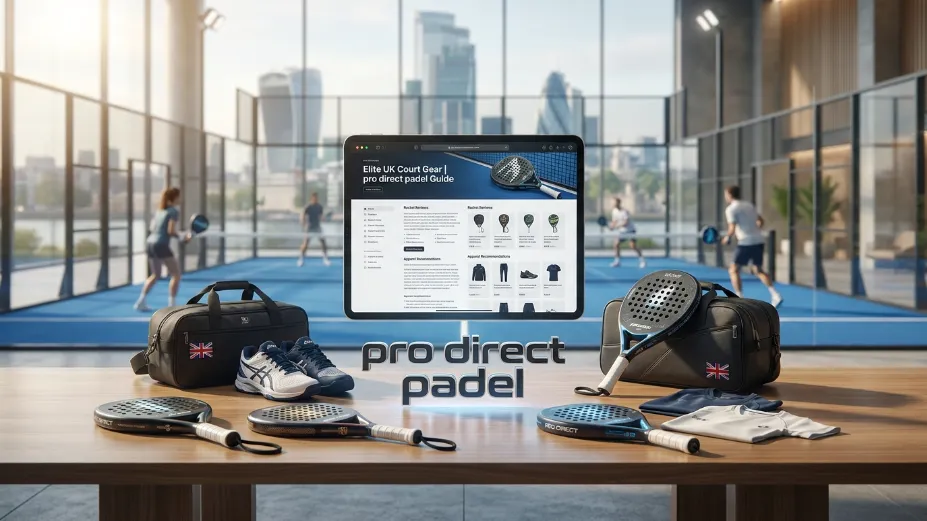
The difference between a crisp, spinning bandeja and a baseline disaster isn’t just your wrist action; it is the millimeter of carbon fiber in your hand and the atmospheric pressure in your sleeve. When the UK padel boom transitioned from a trendy hobby into a fierce weekend obsession, high-street sports shops simply couldn’t keep up with the technical demands of advanced players. You don’t just need gear; you need elite distribution. Navigating the premium catalogue at pro direct padel has become the definitive benchmark for British players who refuse to compromise on response, durability, and court authority. Below is the strict engineering reality of the top-tier gear dominating UK courts this season.
Pro Direct Padel — Premium Gear Comparison
Category · Brand · Model · Benefit · Level · RRP
For intermediate to advanced UK players seeking maximum ball bite and spin value on damp courts, the padelized aero pro tour padel racket offers unparalleled aerodynamic clearance. Alternatively, tournament-level competitors prioritising absolute defensive redirection and a massive sweetspot should opt for the head gravity pro padel. Budget-conscious clubs or players looking for consistent atmospheric flight are best served by purchasing a bulk box of dunlop pro padel balls.
Experiential Retail & On-Court Tryouts
The standard digital purchasing pipeline for premium pro padel equipment has historically suffered from a significant physical limitation: the inability to calculate swing-weight response before investing premium capital. To bridge this information gap, the modern ecosystem has evolved past flat webpage listings into experiential retail hubs. Leading technical partnerships have established dedicated physical test spaces, such as those operating near the padel yard, where players can transition directly from digital item configuration to structural on-court trial centers.
These specialized trial facilities utilize ultra-high-speed camera arrays and localized trackpads to capture real-time kinematic metrics. When an athlete swings a premium model, integrated AI diagnostic software maps the precise velocity, angular deviation, and acceleration of the tip. This diagnostic reality prevents the classic error of purchasing an elite racket based solely on aesthetic design or professional endorsements. Instead, players receive an automated data log detailing localized wrist-joint stress and exact ball-exit speeds, ensuring their chosen frame integrates perfectly with their natural biomechanical pathways.
The Aerodynamics & Durability of dunlop pro padel balls in the UK Climate
The physical criteria governing high-performance ball engineering are frequently misunderstood, leading many transitioning players to ask: are padel balls the same as tennis balls? While they appear visually identical, international governing bodies enforce distinct internal pressure profiles and dimensional boundaries. A standard tennis ball is engineered for a significantly higher internal pressure configuration, typically translating to an uncontrolled, hyper-reactive rebound when introduced into a confined 10-by-20-metre court. In contrast, dedicated padel spheres require a precise internal pressure envelope to manage rebound velocity within glass-walled environments.
Operating within the notoriously volatile UK climate introduces severe environmental stresses that instantly degrade low-tier rubber compounds. When cold, high-humidity air saturates standard woven felt, the material absorbs moisture like a sponge, dramatically increasing total mass and altering aerodynamic drag equations. This is where the advanced materials science of dunlop pro padel balls becomes essential. Dunlop utilizes an elite, high-density synthetic felt weave treated with hydrophobic polymers that actively repel water molecules, effectively avoiding the dreaded “heavy ball” syndrome during damp autumn and winter sessions.
When subjected to a direct comparative analysis against competing models like the HEAD Pro or Pro S series, the specialized core construction of Dunlop exhibits superior gas-retention properties. Under low temperature conditions, gas molecules naturally contract according to basic thermodynamic laws, causing standard cores to suffer an immediate drop in internal pressure. The Dunlop design combats this via a premium natural rubber core reinforced with core-stabilizing compounds. This specific barrier retains an optimal internal pressure range longer than its competitors, ensuring a predictable, crisp launch angle and preventing structural fluffiness over extended multi-hour match play.
Engineering Mastery of the padelized aero pro tour padel racket
For mid-tier and advanced operators aiming to control the transition zone, the geometric architecture of the padelized aero pro tour padel racket represents a significant achievement in structural physics. This premium frame is engineered around a meticulously balanced round profile with a total surface area of 460 square centimetres. By distributing mass evenly around a centralized sweetspot, the design ensures a remarkably stable moment of inertia. Featuring a standard 38mm beam width and a 365g headlight balance profile, this racket allows players to quickly reposition the face during fast, close-range net exchanges without exposing the wrist to harmful torque forces.
The critical factor separating the elite “Tour” variant from its lower-tier “Team” counterpart lies within the advanced surface texturing applied to the face. The Tour edition incorporates a proprietary ProSkin™ finish—a highly defined, deep-grooved silica grit layer baked directly into the outer raw carbon fiber matrix. When executing high-shear topspin or a slice bajada, this rough surface grips the synthetic felt of the ball, maximizing dwell time and generating immense RPM. The smoother face of the Team edition, conversely, prioritizes quick energy transfer and linear rebound, making it less effective for advanced players who rely on complex spin mechanics to keep the ball low off the rear glass.
Is the head gravity pro padel Racket Worth the Weight?
As the signature model of professional competitor Eduardo Alonso, the head gravity pro padel is engineered specifically for tournament players who demand uncompromised defensive control and pinpoint directional accuracy. The structural core of this premium racket utilizes an innovative Auxetic 2.0 carbon-fiber and fiberglass hybrid face. This unique material reacts dynamically upon impact: it expands under tension and contracts under compression, providing immediate, highly detailed sensory feedback. Combined with a dense Control Foam core, this layout absorbs excess kinetic energy, allowing players to safely redirect high-velocity attacks deep into the opponent’s corners.
However, navigating this level of elite control requires an honest assessment of its physical weight distribution. The bare frame registers a substantial static weight of roughly 370 grams. When an advanced player customizes the handle with a Hesacore undergrip and multiple overgrips to adjust ergonomics, the total operational weight frequently reaches a heavy 377 grams. This high mass profile shifts the swing-weight significantly upward. While this added mass provides excellent stability against fast drives, it demands high forearm and shoulder conditioning to prevent chronic wrist strain and fatigue over a three-set match.
Direct Technical Comparison: Head-to-Head Battle with Top Competitors
To accurately assess these premium options, we must contrast their performance profiles directly against the market alternatives dominating British courts. When placing the Padelized Aero-Pro Tour side-by-side with the popular Bullpadel Vertex series, a distinct difference in philosophy emerges. The Vertex relies on a diamond-shaped, head-heavy distribution designed almost exclusively for explosive overhead power, which can feel clunky and unresponsive during desperate defensive recoveries. The Padelized model, with its aerodynamic headlight configuration, delivers vastly superior maneuverability, allowing quick wrist adjustments when digging out low balls near the side walls.
Similarly, comparing the HEAD Gravity Pro to a traditional soft-core control racket reveals a major difference in ball exit behavior. Soft-core options rely on a trampoline effect that provides effortless depth but can easily lead to unpredictable pop-ups on high-speed impacts. The Gravity Pro’s combination of an Auxetic 2.0 hybrid face and dense Control Foam requires the player to provide the driving force. In return, it offers absolute placement precision that soft-faced competitor rackets simply cannot replicate, giving tactical players complete confidence when hitting targets at high speeds.
Tactical Customisation Guide for UK Weather
The intense seasonal shifts across the United Kingdom demand concrete modifications to your equipment setups if you want to maintain a consistent performance profile year-round. To help you optimize your gear, consider the following seasonal configurations:
- Winter & Wet Conditions Setup: During freezing, high-humidity winter sessions, air density increases and the ball core naturally loses pressure. To compensate for this loss of rebound, smart players switch to a slightly higher elasticity frame or drop down to a single thin overgrip to maximize feel. More importantly, always open a fresh can of high-density felt balls prior to every match to ensure adequate court clearance.
- Summer & Dry Conditions Setup: When summer temperatures rise, internal core pressures expand, creating a highly explosive, fast-flying ball. To maintain control under these conditions, players should pair a control-oriented frame like the Gravity Pro with fresh overgrips to absorb sweat. This combination allows you to safely swing at full speed without sending the ball long past the back glass.
Furthermore, maintaining traction on damp artificial grass carpet requires a specialized approach to footwear. Standard tennis shoes lack the specific tread patterns required to clear trapped moisture from the court surface. Investing in dedicated padel shoes featuring deep herringbone or multi-directional omni-tread outsoles ensures reliable traction during sudden lateral changes of direction. This custom technical foundation prevents dangerous slipping out on wet courts, allowing you to move safely and aggressively in any weather.
Frequently Asked Questions (FAQ)
Q1: Why do my padel balls feel heavy and flat in winter, and which ball solves this in the UK?
A1: According to basic gas laws, low winter temperatures cause the gas molecules inside a standard core to contract, resulting in a lower internal pressure and a flat, dead response. Additionally, high atmospheric humidity allows low-grade outer felt to absorb water weight, making the ball physically heavier. Upgrading to premium dunlop pro padel balls solves this issue, as they utilize a hydrophobic synthetic felt weave and a specialized rubber core compound engineered to retain pressure in cold weather.
Q2: How can I try a premium padel racket under real court conditions before purchasing?
A2: Rather than buying a high-end frame blindly online, advanced players should utilize specialized experiential retail programs linked with real physical locations, such as the trial centers operating near the padel yard. These centers feature on-court demo setups equipped with camera tracking arrays and diagnostic software, allowing you to analyze your swing-weight analytics and forearm stress before finalizing your purchase.
Q3: What is the exact difference between the “Tour” and “Team” editions of the Padelized Aero-Pro rackets?
A3: The difference centers on the surface texturing and its impact on ball friction. The premium Tour variant features a deep-grooved ProSkin™ silica grit texturing baked directly into the carbon face, which dramatically increases ball bite for maximum spin. The Team edition features a smoother face finish designed for clean, linear power transmission, making it better suited for developing players who focus on flat hitting rather than heavy spin.
Q4: Will the HEAD Gravity Pro help me generate more power on my smashes?
A4: No, the Gravity Pro is intentionally not engineered as a free-power weapon. It features a dense Control Foam core and an Auxetic 2.0 hybrid face designed to absorb excess energy and provide high placement precision. If you want to generate high-velocity smashes with this racket, you must rely on clean body mechanics, a fast swing speed, and striking the sweetspot perfectly to overcome the core’s natural dampening properties.
Q5: How do overgrips and accessories affect the handling of a control racket?
A5: Adding weight modifications like a Hesacore undergrip and multiple overgrips will increase the static weight of your setup by 7 to 10 grams. While placing this mass at the base of the handle maintains a headlight balance profile, the overall increase in mass raises the moment of inertia. This extra weight provides greater stability against fast attacks, but demands higher muscle conditioning to avoid forearm fatigue and maintain quick net maneuverability.