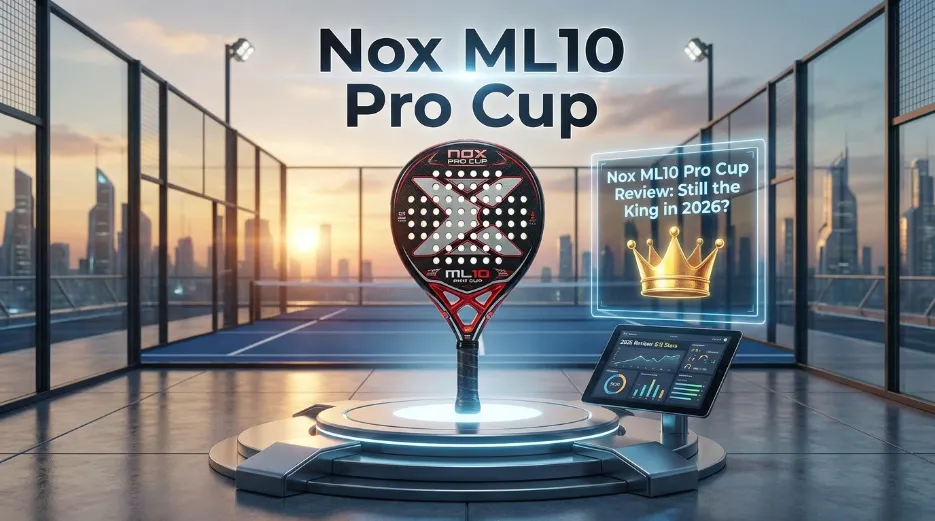
Every padel court across the UK tells the same cold-weather story: damp synthetic turf, heavy humid air, and a ball that suddenly feels like a brick off the glass. While flashy, ultra-rigid carbon frames promise explosive power, they often collapse into dead touch and harsh arm vibration the moment temperatures drop below 10∘C. This exact environmental penalty is why the nox ml10 pro cup has quietly dominated competitive UK club play for over a decade. Designed around immediate structural elasticity and effortless depth, Miguel Lamperti’s iconic blueprint delivers the precise blend of soft defensive feel, sweet-spot forgiveness, and all-weather control required to master British playing conditions.
ML10 Pro Cup Range Comparison
Classic · Rough Surface · Luxury
For players operating on UK courts who prioritise maximum baseline consistency, forgiving touch, and effortless depth, the standard ML10 Pro Cup Classic remains the undisputed benchmark. If you frequently play on damp outdoor carpet surfaces and need mechanical grip for slicing, select the nox ml10 pro cup rough surface edition. Advanced players seeking greater face stiffness for explosive overhead smashes without sacrificing round-shape control should choose the nox ml10 pro cup luxury model.
Comprehensive Nox ML10 Pro Cup Review: Hands-On Performance Breakdown
To truly understand why the nox ml10 pro cup review scores consistently at the top of independent tests year after year, one must analyze how it handles during real-world tactical play. From the moment you step onto the court, the racket feels instantly familiar. There is zero learning curve required—a rarity among high-performance frames.
At the back of the court, the combination of a low balance point and the quick elastic recovery of the HR3 EVA rubber provides phenomenal low-speed ball exit (salida de bola). When defending deep wall bounces or absorbing aggressive overhead drives from opponents, you do not need to execute a massive backswing to clear the net. A short, compact stroke block sends the ball deep into the opponent’s court with pin-point trajectory control. Check out the Official Nox Sport Website for official technical certificates and specs.
When transitioning to the net, volleying feels crisp and stable. The wide sweet spot ensures that even off-centre impacts near the perimeter retain direction and pace. While pure power hitters might miss the top-heavy whip of a diamond-shaped frame, the smash output of the ML10 Pro Cup is surprisingly authoritative. When hit with clean technique at the apex of the swing, the dense core compresses fully to transfer direct kinetic energy, allowing you to kick the ball out over the 3-metre side wall (por tres) with remarkable reliability.
1. Structural Architecture and Engineering of the ml10 pro cup nox
The engineering secrets underlying the ml10 pro cup nox series reside in its intelligent composite material layering and structural perimeter support. While modern market trends lean heavily toward rigid, full-carbon faces, Nox has retained its signature metallic-finish glass fibre formula for a reason: mechanical compliance.
- 100% Carbon Frame: The outer structural ring utilizes a high-tensile carbon tubular matrix that prevents frame distortion under high-impact collisions with walls or adjacent frames.
- Dynamic Composite Structure (DCS): Nox applies up to four centimetres of additional carbon material from the outer frame border inward into the facial plane. This reduces the flexural hardness differential between the frame edge and the central hitting zone, mitigating shear strain and extending frame fatigue life.
- HR3 High-Density Core: The dark elastomeric core features rapid elastic memory response. It absorbs initial ball momentum before returning to its resting state rapidly, delivering effortless depth on defensive lobs.
- Metallic Fibre Glass Silver Facings: Three distinct layers of aluminized glass fibre provide a touch that bridges the gap between ultra-soft fiberglass and unforgiving hard carbon. Explore the broader Nox padel racket line-up to see how this core configuration compares across the range.
- Smartstrap® Lanyard System: A modular replacement assembly that allows players to change handle straps quickly for hygiene or preference without opening the butt-cap mechanism.
- Nox Custom Grip: Certified by Testea Padel, this silicone ring system mounts directly over the bare handle, absorbing up to 29% of structural vibration while increasing hand grip friction by 52%.
2. Complete Model Taxonomy: Classic, Rough, and Luxury Variations
The expansion of the ML10 blueprint has produced specialized sub-variants tailored to specific physical capabilities, surface preferences, and court tempos. Understanding these subtle structural shifts ensures you invest in the exact frame that elevates your tactical game.
The Baseline Icons: Classic, Black Edition, and Silver
The standard ML10 Pro Cup Classic and Black Edition share identical internal compositions, offering 360–375 grams of weight, a low-to-medium balance point, and a smooth gloss finish over Fibre Glass Silver planes. The Black Edition provides a dark, sleek aesthetic for players who prefer a stealthy on-court appearance. For players seeking lighter swing weights, the ML10 Pro Cup Silver operates within a 350–365 gram tolerance band, significantly reducing rotational inertia for rapid net reactions. If you are starting your journey, consult our detailed beginner padel racket guide to evaluate lighter frame dynamics.
The Textured Spin Variant: Nox ML10 Pro Cup Rough
The nox ml10 pro cup rough edition retains the exact shape, weight distribution, and core composition of the Classic model, but introduces a sprayed silica sand micro-finish across the striking face. This tactile quartz coating increases frictional drag against the acrylic felt of the ball, allowing players to impart aggressive underspin on slice volleys and tactical lobs.
The Carbon Upgrade: Nox ML10 Pro Cup Luxury
Engineered for advanced players who demand stiffer feedback, the nox ml10 pro cup luxury replaces glass fibre facings with 3K interwoven carbon fibre. It also incorporates lateral Anti-Vibration System (AVS) rubber dampers embedded directly into the bridge throat. This structural upgrade delivers a firmer impact feel, dampens unwanted frame flex during heavy smashes, and expands directional accuracy on fast drives. Intermediate players considering this step up can review our collection of the best padel rackets for intermediate players.
Specialised Geometry Variants: Survivor Gris and Ultra Light
The ML10 Survivor Gris incorporates a higher-density HR3 Black EVA rubber core finished with a matte exterior, delivering an intermediate-to-hard impact feel suited for warm weather. Meanwhile, the ML10 Pro Cup Ultra Light caters to junior players or those recovering from arm fatigue, dropping weight down to 310–325 grams while maintaining adult face geometry over a softer HR2 core.
3. Head-to-Head Comparison: Classic vs Rough vs Luxury
When selecting between these three flagship variants, evaluating their head-to-head performance across specific court scenarios reveals clear functional distinctions:
- Baseline Touch & Lobbing: The Classic and Rough editions excel here. The compliance of the Fibre Glass Silver planes allows deep, towering lobs with minimal physical effort. The Luxury edition requires slightly more arm acceleration to push the ball deep due to its stiffer 3K carbon face.
- Spin Generation & Slice Control: The nox ml10 pro cup rough surface easily wins on aggressive slice volleys (bandejas and viboras). The silica sand grit bites immediately into the ball felt. The Luxury model’s 3D relief pattern offers consistent medium spin, whereas the smooth Classic model relies entirely on player wrist speed and contact angle.
- Overhead Smash Authority: The Luxury model takes the lead when stepping up to smash. Its 3K carbon weave eliminates energy loss caused by face flexing, delivering maximum velocity on hard flat smashes. The Classic and Rough models provide plenty of punch for intermediate play, but can “bottom out” slightly during maximum-power overheads.
- Durability & Weather Resistance: The Luxury model’s 3K carbon plane is virtually immune to micro-cracking over extended play. The silica sand on the Rough model naturally wears down over 8–12 months of intense play, slowly transitioning toward a smooth feel in the central sweet spot.
For more detailed advice on selecting between core stiffness levels, read our full guide on how to choose a padel racket.
4. Surface Friction Engineering: Sand Roughness vs 3D Relief
Frictional interaction between the racket plane and ball felt determines how much rotational torque you can apply. Nox utilizes two distinct texturing methodologies across the ML10 ecosystem:
The nox ml10 pro cup rough surface utilizes a post-cure silica sand coating bonded with a polyurethane resin binder. This micro-roughness creates exceptionally high static friction. When executing a tactical slice drive or executing a controlled bandeja, the quartz grit grabs the ball felt tightly, preventing slip and producing immediate rotation.
In contrast, the Luxury series features 3D hexagonal relief thermoformed directly into the outer carbon resin during frame curing. While 3D relief has a slightly lower friction coefficient than fresh silica sand, it suffers zero wear degradation over time. The structural pattern remains 100% intact throughout the entire operational life of the racket frame.
5. Performance Mechanics in United Kingdom Environmental Conditions
Playing padel in the United Kingdom presents unique material challenges. Outdoor courts, covered canopies, and unheated indoor centres frequently experience temperatures dropping below 10°C during winter months, combined with high humidity and heavy air density.
Under cold ambient conditions (<= 10°C), elastomeric EVA rubber cores undergo thermal contraction and viscoelastic stiffening. Rigid 100% carbon rackets can feel uncomfortably hard in winter, transmitting harsh shocks up the arm. However, the metallic glass fibre faces of the ML10 Pro Cup Classic and Rough models offset this cold-weather hardening. The compliance of the glass fibre keeps the sweet spot feeling broad and springy, ensuring you retain deep ball exit even when playing on cold, damp carpet courts. If you regularly battle UK weather, explore our round-up of the top-rated padel rackets in the UK.
6. Ergonomic Comfort, Joint Shock Attenuation, and Biomechanics
Repetitive impact shock transmitted through the handle is a primary contributor to joint fatigue and forearm soreness. The ML10 Pro Cup architecture is widely celebrated by coaches and physical therapists for its forgiving, shock-absorbing design.
Because the round shape places the centre of mass close to the player’s hand, rotational inertia (swing weight) is kept low. This reduces the strain placed on the wrist during quick defensive blocks at the net. Furthermore, the higher compliance of glass fibre extends the ball contact duration (Δt), spreading peak shock forces over a longer timeframe and significantly lowering impulse stress transferred to the elbow joint. Players seeking maximum comfort can also review our dedicated list of the best padel rackets for tennis elbow or consider the shock-dampened Nox Equation Padel Racket.
7. Strategic Player Progression and Upgrade Roadmaps
Selecting the ideal ML10 model depends entirely on your current skill level, physical strength, and court role:
- Phase 1 (Beginner to Intermediate Control): Start with the ML10 Pro Cup Classic or Rough Surface. Focus on establishing consistent lobbing, defensive wall returns, and precise net positioning.
- Phase 2 (Intermediate Attacking Transition): As your swing speed increases and you begin attacking overheads more aggressively, upgrade to the ML10 Pro Cup Luxury 3K. This provides a stiffer striking plane for faster smashes while preserving round-mould defensive forgiveness.
- Phase 3 (Advanced Tournament Play): High-level attackers seeking aggressive teardrop geometry and higher balance can eventually step up to the Nox AT10 Genius series, leveraging carbon facings and elevated levers for maximum smash power.
Frequently Asked Questions (UK Player Guide)
Q1: Is there any functional performance difference between the ML10 Classic and Black Edition?
No. The ML10 Pro Cup Classic and Black Edition share 100% identical structural specifications, including the 100% carbon frame, HR3 EVA core, Fibre Glass Silver planes, weight range (360–375g), and low-to-medium balance point. The only difference is cosmetic.
Q2: Will playing in damp UK rain damage the silica sand on the ML10 Pro Cup Rough Surface?
Moisture itself will not dissolve the silica sand coating, as it is sealed with waterproof polyurethane resin. However, hitting heavy, waterlogged balls accelerates natural friction wear. Always wipe your racket face dry with a microfiber towel post-match.
Q3: How does adding an overgrip or Nox Custom Grip affect the balance of the racket?
Adding a single overgrip or installing the Nox Custom Grip adds approximately 5 to 10 grams to the handle base. Because this weight is added below your hand contact point, it slightly lowers the racket’s effective balance point, making it feel even more manoeuvrable in defense.
Q4: Is the ML10 Pro Cup Silver strictly designed for female players?
Not at all. While the Silver edition features subtle pink accents, its core engineering objective is lower weight (350–365 grams). It is an excellent choice for any player—male or female—seeking a lighter swing weight to reduce wrist fatigue during long matches.