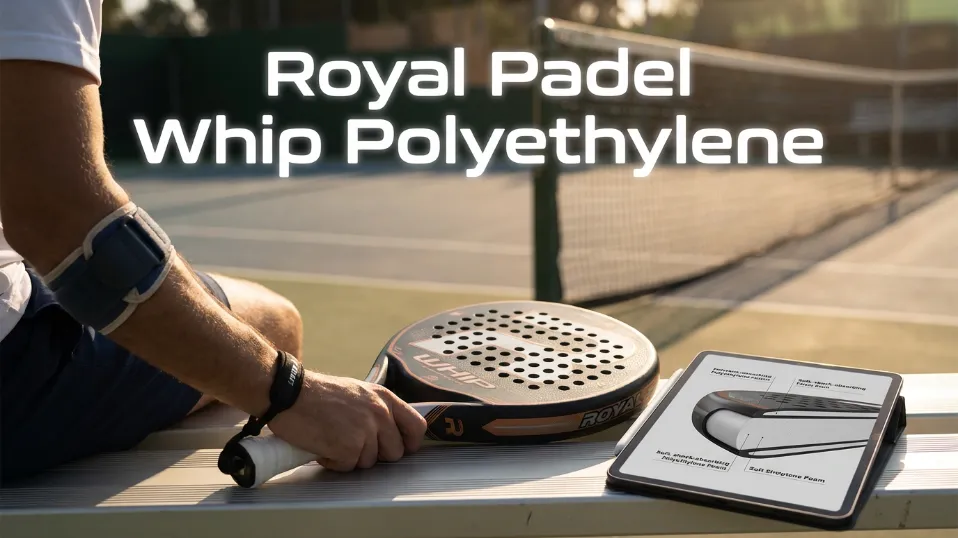
Let’s be honest: nothing ruins a brilliant match quite like the sharp sting of tennis elbow or a racket that feels like swinging a concrete block. If you’ve been endlessly searching for the holy grail of vibration absorption without sacrificing your control on the court, your search might just end here. Enter the Royal Padel Whip Polyethylene – a racket that has quietly built a cult following across UK padel clubs. But does its legendary soft core actually live up to the hype, or is it just clever marketing? Let’s dive deep into the details and see if this is the upgrade your game has been waiting for.
The Technical Anatomy: Understanding the Polyethylene Difference
In a market saturated with high-density EVA (Ethylene Vinyl Acetate) foams, the royal padel rp 790 whip polyethylene stands out by sticking to its roots. But what exactly makes polyethylene (PE) different? From a material science perspective, PE foam has a lower density and higher elastic memory than standard EVA. While most professional rackets use EVA densities ranging from $30 \text{ kg/m}^3$ to $50 \text{ kg/m}^3$, the PE core in the Whip series typically sits between $15 \text{ kg/m}^3$ and $25 \text{ kg/m}^3$.
This lower density translates into Polyethylene core padel racket benefits that you can feel from the first strike. The most notable is the “dwell time”—the fraction of a second the ball remains in contact with the racket face. Because the core is softer, it compresses more significantly upon impact, cradling the ball before launching it back. This creates an effortless “Salida de Bola” (ball output), allowing players to defend deep lobs and tricky low balls with minimal arm effort. When you Buy Royal Padel Whip UK, you are essentially investing in a racket that does the heavy lifting for you in defensive transitions.
The frame itself is a sophisticated blend of bidirectional fibreglass tubular construction reinforced with carbon fibre. This “Fibertech” technology ensures that while the core is buttery soft, the structural integrity of the racket remains intact, providing enough rigidity to maintain accuracy during volleys. For more insights on equipment selection, check out the how to choose a padel racket guide.
Ergonomic Excellence: The Best Padel Rackets for Tennis Elbow
If you have ever suffered from lateral epicondylitis, you know that every vibration felt through the handle is a step back in your recovery. This is where the Royal Padel Whip Polyethylene truly earns its “King of Comfort” title. Royal Padel has engineered a multi-stage vibration dampening system that is arguably the most effective in the industry.
- Primary Absorption: The soft PE core acts as the first line of defence, soaking up the initial shockwave of the ball’s impact.
- Shock Absorption System: Located in the heart (the bridge) of the racket, this central reinforcement is designed to break the vibration waves before they can travel up the handle to your wrist and elbow.
- Aluminised Fibreglass Faces: Unlike stiff 12K or 18K carbon faces that transmit high-frequency vibrations directly to the arm, the aluminised fibreglass used here provides a more flexible hitting surface that further reduces stress on the joints.
For British players transitioning from tennis or those playing 3-4 times a week at clubs like padel rackets in the UK, this level of protection is a game-changer. It is consistently rated as one of the best padel rackets for tennis elbow because it prioritises joint health without turning the racket into a “mushy” mess. You get a muted, dampened feel that tells your brain the impact was solid, without your elbow feeling the price of that power.
Performance in the UK Climate: Dealing with Cold and Damp
One angle often missed in standard Royal Padel Whip Polyethylene review UK articles is how the material reacts to the unique British weather. Padel is increasingly an outdoor sport in the UK, and temperature plays a massive role in polymer behaviour. As temperatures drop below $10^\circ\text{C}$ in the winter, both EVA and Polyethylene naturally harden. However, because PE starts at a much lower density, it remains playable and comfortable even in near-freezing conditions where a “hard” carbon racket would feel like hitting a stone.
During damp sessions, the “heavy” felt of a wet padel ball can put immense strain on a player’s arm. The Whip Polyethylene’s elastic core compensates for this extra weight, providing the necessary “spring” to keep the ball moving despite the humidity. If you frequently play on uncovered courts, follow the LTA Padel guidance for safe play in varied conditions.
The Generational Evolution: 2024 vs. 2025/2026 Models
Royal Padel has recently updated the Whip range, and the changes have sparked significant debate on forums like Reddit and Quora. The 2026 model introduces several key refinements:
The Hole Pattern Controversy
Traditionally, the Royal Padel Whip Polyethylene featured a “cross” hole pattern, leaving the centre of the racket (the sweet spot) solid. The theory was that a solid centre improved core durability and vibration dampening. The new 2025 and 2026 models have moved to a more distributed “butterfly” pattern. While some purists argue this makes the hit feel slightly “crispier” and less dampened, most players report an expanded sweet spot and better manoeuvrability. The distributed holes reduce air resistance, making the racket faster through the air during high-intensity rallies.
DMND Spin Rough Surface
Another major upgrade is the introduction of the DMND Spin Rough surface. Previous iterations of the Whip were sometimes criticised for having a smooth face that made it difficult to “grip” the ball for slices or top-spin. The 2026 version features a dual-texture finish: a textured centre for controlled volleys and a sandpaper-like finish on the edges to maximise spin on off-centre hits. This is particularly useful in the UK, where moisture on the ball can often lead to it “skidding” off the racket face.
Whip Polyethylene vs. M27 Polyethylene: Which Should You Buy?
A common question for intermediate players is whether to stick with the Whip or upgrade to the more expensive M27 series. Here is the technical breakdown:
- Materials: The M27 is constructed with 100% 3K Carbon, whereas the Whip uses a fibreglass/carbon hybrid. This makes the M27 more durable and powerful, but also slightly less “cushioned” than the Whip.
- Feel: The Whip offers the classic “buttery” feel that Royal Padel is famous for. The M27 provides more technical feedback, which advanced players prefer for precision placement.
- Price Point: In the UK market, the Whip sits comfortably in the £160-£180 range, making it the best padel racket for intermediate players who want elite technology without the £250+ price tag of the R-Line.
If your primary concern is injury prevention, the Whip is actually the superior choice. If you have fully recovered and want to add more “zip” to your overheads, then you might consider the M27. For more on high-performance options, see our list of best padel rackets for tennis elbow.
Maintenance and Longevity in the British Isles
Because the Polyethylene core is more elastic, it does have a slightly shorter lifespan than hard EVA rackets. A regular club player in the UK (playing 3 times a week) can expect the core to lose its optimal “spring” after about 10-14 months. To extend the life of your royal padel rp 790 whip polyethylene, follow these expert tips:
- Use a Thermal Bag: Temperature swings are the enemy of PE foam. Never leave your racket in a cold car overnight. Use a bag with a thermal lining to keep the core stable.
- Dry After Play: If you play in the rain or high humidity, wipe the frame and faces with a microfibre cloth immediately. Moisture seeping into the holes can weaken the internal adhesives over time.
- Replace Overgrips Frequently: In the damp UK climate, overgrips can become “mucky” and lose their tackiness, causing you to grip the handle too tightly. This “death grip” is a leading cause of elbow pain, regardless of how good your racket is.
Final Verdict: Is it Worth it?
The Royal Padel Whip Polyethylene is not a racket for everyone. If you are a “big hitter” who wants to smash the ball out of the court on every point, the soft core will likely frustrate you by absorbing too much of your power. However, if you are a strategic player who wins points through placement, consistency, and best padel racket for intermediate players style defensive lobs, this racket is a masterclass in design.
For the UK player, it offers a unique combination of cold-weather performance and world-class injury protection. It remains the benchmark for comfort in a sport that is notoriously hard on the joints. If you value your longevity on the court as much as your win-loss record, this is arguably the smartest investment you can make this season.
Frequently Asked Questions (FAQ)
1. How long does the Polyethylene core last before it goes ‘soft’?
On average, the PE core maintains its premium properties for 150-200 hours of play. For most UK club players, this means replacing the racket every 12 months to maintain that signature ‘ball output’.
2. Is the Royal Padel Whip Polyethylene good for beginners?
Yes, but with a caveat. Its large sweet spot and soft feel make it very forgiving for learners. However, beginners may find the ‘trampoline effect’ hard to control initially, leading to balls hitting the back glass too often.
3. What is the difference between the ‘Whip Poly’ and the ‘Whip Hybrid’?
The Hybrid version mixes Polyethylene with EVA foam. This creates a slightly harder touch and more power for smashes, but it transmits more vibration than the pure Polyethylene version reviewed here.
4. Does it come with a frame protector?
Most UK retailers include a standard transparent protector. Given the fibreglass construction of the frame, we highly recommend applying a high-quality bumper to protect against wall impacts.
5. Why is the handle shorter than other brands?
Royal Padel traditionally uses a slightly shorter handle to keep the balance lower (towards the hand). This increases manoeuvrability and reduces the ‘leverage’ stress on the wrist during quick volleys.
Conclusion
The Royal Padel Whip Polyethylene continues to be a specialist tool for a specific type of player. It doesn’t try to be the most powerful racket on the market; instead, it strives to be the most comfortable. In the evolving landscape of UK padel, where players are becoming more educated about joint health and technical specs, the Whip series remains a vital option for anyone looking to play pain-free for years to come.