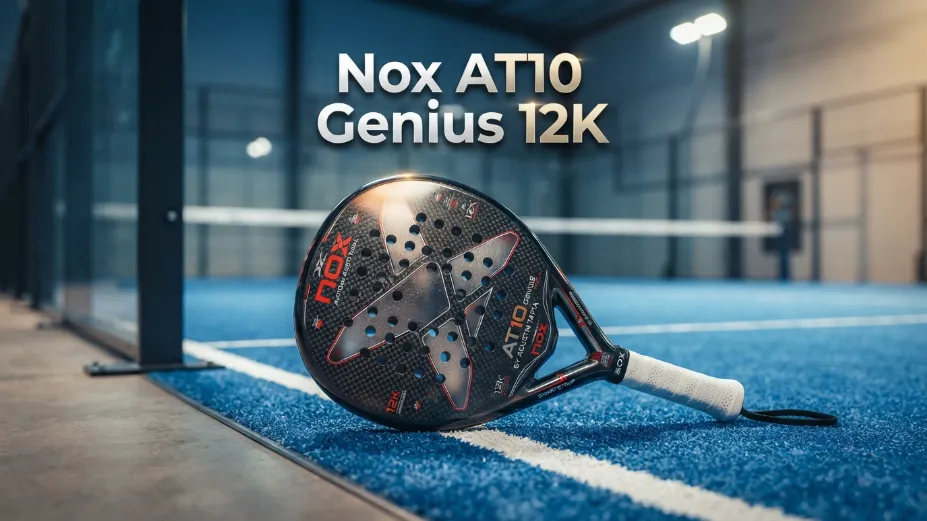
Agustín Tapia didn’t dominate the World Padel Tour by relying on gear that compromises between raw power and surgical control. Yet, for players across the UK navigating damp indoor courts and heavy evening air, finding a racket that holds its sweet spot without feeling like a wooden plank remains a constant challenge. The nox at10 genius 12k completely redefines this balance, blending 12K aluminised carbon with a precision-engineered tear shape to offer an unparalleled feel on every counter-attack.
Whether you are weighing up the upgrades in the latest model or deciding if this flagship frame justifies the investment for your game, this definitive breakdown cuts through the marketing noise to reveal how it truly performs on court.
Padel racket — specs & UK player experience
Official specification · UK on-court impact
Teardrop mould
Medium balance · 260–265mm
12K Alum XTREM Carbon
Aluminised weave
HR3 Black EVA core
High-density memory foam
100% carbon + DCS
Dynamic composite structure
Dual spin texturing
3D hexagonal moulded + silica sand etching
360 – 375 grams
Pulse system + NOX custom grip®
Testea certified
30mm extended handle
Smartstrap® replaceable lanyard
Padel racket — Feature specifications & UK player experience on-court impact.
For UK padel enthusiasts seeking a high-performance balance of defensive agility and net precision, the nox at10 luxury genius 12k stands out as the premier all-court racket available. Its high-density core and temperature-resistant aluminised carbon weave deliver consistent feedback in cold or damp playing conditions, while the extended handle accommodates tennis converts transitioning to two-handed shots. For intermediate to advanced players aiming to elevate their tactical game across UK clubs, it represents an outstanding investment in performance and structural durability.
Nox AT10 Genius 12K Review: Comprehensive On-Court Evaluation
In our rigorous multi-court testing, the Nox at10 genius 12k review reveals a frame engineered specifically for players who demand unyielding precision without sacrificing overhead weaponization. Unlike head-heavy diamond models that can feel unwieldy in defensive rallies, the teardrop geometry of the at10 genius 12k keeps the balance point manageable near the hand. When forced deep into the back corners of unheated UK indoor hangars, the racket allows for rapid wrist adjustments, enabling players to execute low defensive digs off the back glass with minimal preparation time.
The touch on off-speed shots requires an initial period of adjustment. Because the modern 12K Alum XTREM carbon face is crisp and firm, the racket offers virtually zero uncontrolled “trampoline effect.” Soft drop shots (chiquitas) and delicate touch volleys rely entirely on player input and correct hand positioning rather than passive core flex. However, once you master the timing using a proper continental grip technique, directional placement becomes pinpoint accurate. Ball output scales linearly with your swing speed: stroke gently for defensive control, or accelerate forcefully to punch deep block volleys past incoming rushers.
At the net, the frame truly comes alive. The integration of lateral aerodynamic cut-outs—known as the EOS Tunnel system—noticeably cuts down air resistance during fast preparation phases. When contesting rapid volley-to-volley firefights, the racket transitions from forehand to backhand wing effortlessly. Overhead, when executing a slice vibora or a topspin kick smash, the dual surface roughness grips the ball casing firmly. The combination of central 3D hexagonal moulding and perimeter silica sand etching creates significant spin friction, ensuring your bandejas bite low off the opponent’s glass wall rather than popping up into hit-zone height.
Generational Lineage & The Material Inversion (2023 to 2026)
Understanding the architectural evolution of Agustín Tapia’s signature line is essential for selecting the correct model, as NOX executed a complete material hierarchy inversion between the 2023 and modern production runs. Historically, in the 2022 and 2023 lineups, NOX designated its 12K carbon models as the softer, more forgiving options, while the 18K variants featured stiffer, denser structural carbon. However, beginning with the 2024 range and continuing through the nox at10 genius 12k 2025 and flagship nox at10 genius 12k 2026 releases, NOX completely inverted this technical matrix.
In the contemporary range, the 12K carbon face features a tighter, flatter, and significantly more rigid composite weave than its 18K Aluminised counterpart. Consequently, the modern 12K model has stepped into the role of the firmest, most aggressive teardrop frame in the Luxury collection, engineered for players with fast swing speeds who want direct, crisp feedback. Conversely, the 18K Alum model has shifted to provide a slightly softer, more elastic touch, catering to players who favour shock absorption and passive ball depth over maximum surface hardness. For detailed comparisons on the softer sibling, read our complete NOX AT10 Genius 18K Alum 2026 review.
Beyond the carbon weave, the internal core formulation has undergone key refinements. While the 2025 edition incorporated an MLD Black EVA multilayer core to blend low-speed touch with high-speed resistance, the 2026 12K Alum XTREM returns to a high-density, single-block HR3 Black EVA core. This change reinforces core memory retention, ensuring that repeated heavy overhead strikes do not break down the internal rubber matrix over time. Players exploring the broader brand catalog can compare these structural changes against the entire NOX padel racket collection to align foam density with their individual play style.
Head-to-Head Comparisons: 12K vs The Competition & Stablemates
Head-to-Head: Nox AT10 Genius 12K (2026) vs NOX AT10 Genius 18K Alum (2026)
While both frames share identical teardrop moulds, EOS Tunnel aerodynamics, and Weight Balance customisation systems, their dynamic feel on court differs markedly. The 12K Alum XTREM features a flatter, tighter carbon weave paired with a denser core, producing a firm impact sensation with zero lag. This makes it ideal for aggressive net players who like to punch volleys and smash hard. The 18K Alum, by contrast, utilizes a more compliant carbon face that absorbs incoming pace and offers a marginally larger sweet spot.
Intermediate players or those prone to arm fatigue will find the 18K model more forgiving on off-centre hits, whereas advanced competitors looking for pure precision will lean toward the 12K.
Head-to-Head: Nox AT10 Genius 12K (2025) vs Nox AT10 Genius 12K (2026)
Comparing the two latest production runs highlights significant structural improvements. The 2025 model relies on the EOS Flap profile and an MLD Black EVA sandwich core, offering a solid intermediate-to-advanced touch with excellent value at current retail discount rates. However, the 2026 edition introduces 12K Alum XTREM carbon, which reduces fibre crimp by 50% for greater face stability. Additionally, the 2026 model introduces the Weight Balance system, allowing players to fine-tune frame mass via 2g or 4g interchangeable weight plates. If budget permits, the 2026 model offers superior structural consistency across variable weather conditions.
Head-to-Head: Nox AT10 Genius 12K vs Bullpadel Vertex 04 Hybrid & Adidas Metalbone
When placed beside rival flagship frames in the best padel rackets for advanced players category, the AT10 Genius 12K occupies a unique middle ground. The Bullpadel Vertex 04 Hybrid offers a slightly higher balance point with an aggressive diamond-teardrop crossover shape, giving it a slight edge on pure smash power, though it is slightly less agile in quick defensive transitions. The Adidas Metalbone series provides extreme customization via its weight-screw system, but its face touch can feel noticeably harsher on off-centre hits. The AT10 12K stands out by providing elite structural firmness while preserving joint comfort through its certified dual-vibration dampening system.
UK Court Dynamics: Missing Angles Competitors Overlook
Most commercial equipment reviews evaluate padel rackets under ideal Mediterranean conditions: warm, dry air and ambient temperatures exceeding 25°C. However, for padel players across the United Kingdom, local court dynamics are vastly different. Padel in the UK is predominantly played in unheated indoor industrial units or covered outdoor courts, where ambient temperatures regularly fall between 3°C and 12°C for much of the year. Understanding how these cold temperatures affect material performance is vital before purchasing premium padel rackets in the UK.
Cold air causes traditional EVA rubber cores to contract and harden, while standard carbon faces stiffen significantly. On an unheated winter court in London or Manchester, a standard racket’s sweet spot can feel markedly smaller, and its passive core bounce drops dramatically. The 12K Alum XTREM carbon in the modern AT10 Genius addresses this issue through its aluminised surface treatment. By reflecting thermal radiation and resisting environmental cold shifts, the aluminised composite maintains consistent flex characteristics regardless of venue temperature. UK players will not suffer the frustrating drop in feel when moving between a heated reception lounge and an unheated court.
Another area where many reviews fall short is helping former tennis players adjust to padel gear. A large portion of the UK padel demographic consists of tennis converts who naturally favor a two-handed backhand drive or leverage-heavy defensive lobs. Traditional padel handles measure between 110mm and 120mm, forcing the non-dominant hand onto the uncomfortable shaft throat. NOX solves this issue across its Luxury line by incorporating a 30mm extended handle (Oversize Grip).
This added length allows two-handed players to place both hands comfortably on the grip without overlapping, enabling smooth transitions when hitting flat backhand drives or defensive lob escapes. Furthermore, players concerned about joint strain during cold-weather play can review our guide to the best padel rackets for tennis elbow.
Finally, players must adjust their expectations regarding sweet spot placement. Tennis converts often expect the sweet spot to sit high up on the frame tip, similar to modern teardrop-diamond tennis frames. On the AT10 Genius 12K, however, the sweet spot is positioned directly in the geometric centre of the face. Hitting near the top edge on a cold day results in a dead contact feel and reduced exit speed. Engaging the dense central HR3 core cleanly delivers optimal ball propulsion, crisp acoustics, and maximum spin generation when executing a bandeja.
The Full Nox AT10 Genius 12K Family Breakdown
To cater to diverse player preferences, physical capabilities, and tactical styles, NOX has expanded the 12K architecture into a specialized multi-model family for the current season. Choosing the right variant depends on your swing mechanics, physical strength, and strategic role on court. For additional advice on selecting the ideal setup, check our full breakdown on how to choose a padel racket.
- NOX AT10 Genius 12K Alum XTREM (Flagship Model): The definitive teardrop frame built for advanced and competitive players. Features a 100% carbon frame, 12K Alum XTREM face, HR3 Black EVA core, EOS Tunnel aerodynamics, Weight Balance system (2g/4g counterweights), and Photochromic finish paint. Standard weight 360–375g. Ideal for balanced, aggressive all-court players.
- NOX AT10 Genius 12K Alum XTREM Lite: Designed for intermediate players, touch specialists, or players seeking maximum agility without joint strain. Weighing between 355g and 365g, it pairs the rigid 12K Alum XTREM carbon face with a softer HR3 White EVA core. This combination retains crisp surface feedback while providing a more forgiving core bounce and rapid head speed.
- NOX AT10 Genius Attack 12K Alum XTREM: Engineered specifically for left-side offensive players who prioritize smash output above all else. Built on an aggressive diamond mould with a high balance point, an extended handle, a 12K Alum face, and an HR3 Hard EVA core, it shifts the sweet spot upward toward the frame tip to maximize leverage on aerial put-aways.
- NOX AT10 Genius 12K Junior: Developed specifically for young players building technical fundamentals. Features a slim 30mm frame beam (compared to the standard 38mm), a reduced weight range of 300–325g, a round control geometry, flexible fiberglass faces, and a low-density core to encourage clean swing mechanics without joint fatigue.
Frequently Asked Questions
Why is the modern NOX AT10 12K stiffer than the 18K model?
Starting in 2024 and continuing through the 2025 and 2026 releases, NOX inverted its material matrix. Modern 12K carbon features a tighter, less compliant composite weave than 18K Aluminised carbon. As a result, modern 12K models are the firmest, most offensive teardrop options in the lineup, while 18K Alum models offer a softer, more elastic touch.
What are the main upgrades between the 2025 and 2026 AT10 12K models?
The 2025 model uses an MLD Black EVA multilayer core, standard 12K carbon face, and EOS Flap frame cut-outs. The 2026 edition introduces 12K Alum XTREM carbon (featuring a 50% flatter weave), a high-density single-block HR3 Black EVA core, enhanced EOS Tunnel aerodynamics, and the customisable Weight Balance system (+2g / +4g frame inserts).
Is the AT10 Genius 12K suitable for intermediate padel players?
The standard 360–375g 12K model features a rigid surface and dense core that reward precise mechanics and fast swing speeds. Intermediate players seeking the spin and control of the 12K series may find the lighter AT10 12K Alum XTREM Lite (355–365g) or the softer AT10 18K Alum easier to manoeuvre and more forgiving on off-centre hits.
How does cold UK weather affect the performance of the AT10 12K?
Cold ambient temperatures (below 10°C) cause traditional EVA foam cores to contract and stiffen, reducing passive core bounce. However, the aluminised coating on the 12K Alum XTREM carbon face reflects thermal changes, helping maintain consistent surface flex and predictable ball output across cold outdoor or unheated indoor courts.
Does the firm 12K carbon face increase the risk of tennis elbow?
While the 12K carbon face is firm, NOX equips the frame with dual dampening systems certified by Testea Padel: lateral Pulse System rubber inserts and the NOX Custom Grip®, which filters up to 29% of handle vibrations. Players seeking additional joint relief can opt for the softer 12K Lite model or pair their frame with dampening overgrips.
How does the 30mm extended handle benefit tennis converts?
The Oversize Grip adds 30mm of handle length compared to standard padel rackets. This extended length easily accommodates a comfortable two-handed backhand grip for former tennis players, giving them better leverage and stability on defensive backhand drives and lobs.