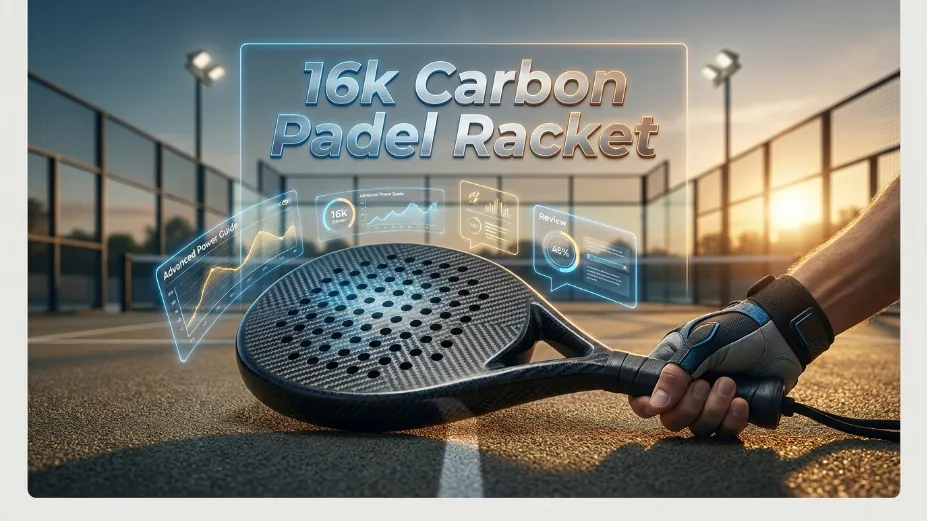
The UK padel boom has officially graduated from a casual Sunday hobby to a fierce, high-calibre competition. As court speeds adapt to the British climate, standard fibreglass frames simply cannot keep pace with the aggressive drive of an advanced player. To dictate the rally from the back of the cage, your weapon of choice requires a surgical blend of explosive power and uncompromising structural memory. This is exactly where the 16k carbon padel racket steps onto the court—not as a subtle upgrade, but as a definitive power play for those who refuse to compromise on ball output.
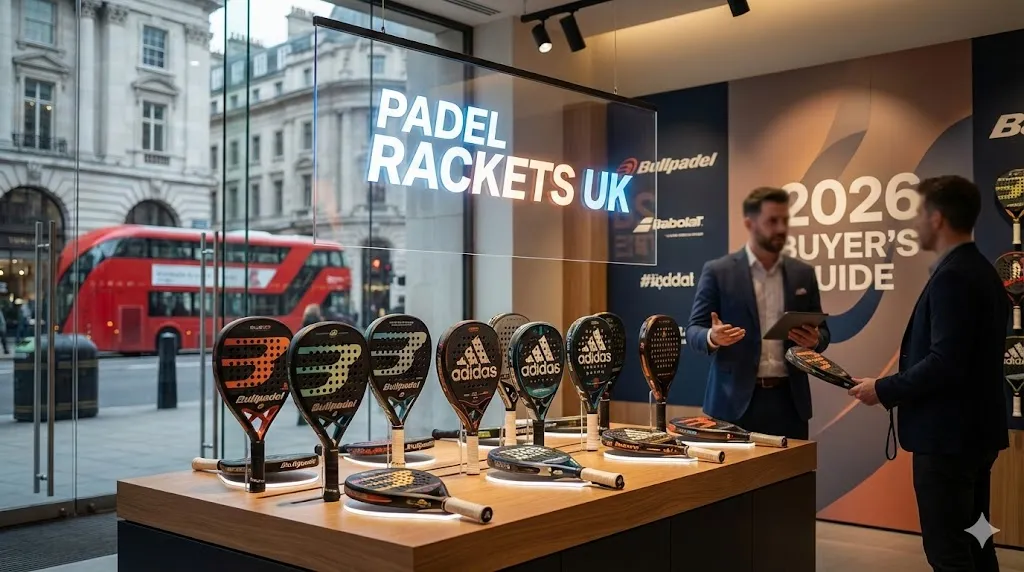
Padel Rackets UK 2025–2026
Carbon & Core · Balance · Price (£) · Performance Benefit
Quick Answer for Players: For advanced players looking to master outdoor UK courts, the ultimate recommendation hinges on balancing structural rigidity with environmental protection. The Adidas Metalbone HRD+ 2026 stands out as the premium choice for raw power due to its thermal-resistant layer, while the Babolat Air Viper 2026 delivers unmatched quickness at the net. If cost-efficiency is paramount, the Dunlop Galactica Pro provides an incredibly stable intermediate stepping stone without exposing the arm to structural instability.
An Analytical 16k carbon padel racket review: Structural Layout & Mechanics
To fully comprehend why a 16K weave completely alters on-court performance, we must dissect the material science hidden beneath the cosmetic paint. A 16K carbon face signifies that precisely 16,000 fine carbon filaments are bound into each woven tow. This creates a broader, flatter ribbon pattern than what you find on historical frames. When evaluating a professional 16k carbon padel racket review, elite players consistently emphasize the unique structural distribution of this specific weave density.
Unlike tighter, dry configurations that result in a harsh, unforgiving feel, the modern 16K carbon layout yields a beautifully elastic matrix. This structural logic is critical when identifying the best padel rackets for advanced players. The flattened ribbons distribute mechanical stress perfectly across a standard 38 mm thickness, ensuring that structural memory remains crisp through thousands of heavy smashes. It actively prevents microscopic fractures from developing within the hitting face, providing premium longevity that justifies the higher initial investment.
- Optimised Filament Alignment: Flatter cross-weaves eliminate weak structural points across the hitting face.
- High Energy Retention: Instantaneous recovery of the composite matrix increases natural power output.
- Vibration Dissipation: The wider ribbon network spreads sharp impact forces away from the handle assembly.
The Missing Angle: Micro-Analysis of the Best 16k carbon padel racket Elements
Most commercial evaluations completely overlook how carbon weave densities interact with core polymers under realistic playing scenarios. Finding the absolute best 16k carbon padel racket requires an understanding of structural integration. When 16,000 filaments are braided smoothly, they generate a slightly more flexible outer skin compared to rigid 3K or 12K alternatives. This counterintuitive elasticity means the racket depends heavily on its internal core to define its final identity.
Advanced structural engineering allows the 16K face to expand the effective sweet spot significantly. On off-centre hits, the wider ribbons yield uniformly, preventing the unpredictable ball deflections common with low-grade composite frames. If you are researching how to choose a padel racket for competitive play, tracking how a brand balances face density with core rigidity is the most critical metric. The 16K surface provides the raw framework, but the inner compound decides whether that frame will protect your joints or punish your mistakes.
- Sweet Spot Expansion: Reduced localized stiffness offers a uniform response across the entire face.
- Torsional Stability: Reinforced perimeter walls minimize frame twisting during off-centre volleys.
- Core Synergy: Works beautifully with modern multi-density foams to balance soft feel and explosive speed.
Head-to-Head Comparison: 16K Versus 18K Structural Physics
A frequent point of confusion for competitive club players is the exact mechanical divergence between a 16K face and an 18K face. In a direct head-to-head analysis, an 18k carbon padel racket possesses a higher filament count per strand, making the weave inherently softer, more flexible, and highly elastic. While this sounds advantageous on paper, it introduces distinct mechanical vulnerabilities when utilized on heavy, outdoor courts across the United Kingdom.
The 16K matrix maintains a much firmer structural memory under heavy loads. It does not suffer from the power deflation that occurs when an 18K face is pushed to its absolute limits during maximum-velocity smashes. For players who demand a direct, hyper-responsive feel without the harsh stiffness of a 3K weave, the 16K configuration sits at the absolute pinnacle of structural logic. It bridges the gap between elastic compliance and rigid energy transfer perfectly, guaranteeing that your power is directed entirely into the ball rather than being lost to face deformation.
Navigating the 16k carbon padel racket price: Investment Tier Analysis
When tracking the current market landscape, understanding the baseline 16k carbon padel racket price requires looking at manufacturing steps rather than brand labels. Premium models generally range from £130 up to £340. The variations within this pricing structure are directly tied to the inclusion of specialized frame technologies, such as advanced anti-torsion bridges and specialized environmental coatings designed to combat moisture breakdown.
Investing in a high-calibre 16K frame provides exceptional financial logic for players committed to long-term tournament schedules. Low-cost alternative options often use thin carbon face veneers over generic fiberglass cores, leading to rapid structural decay and a complete loss of elasticity within months. A true premium 16K frame ensures that your structural performance metrics remain completely stable over multiple seasons of intense competitive play, protecting your wallet from frequent replacement costs.
- Premium Tier (£230 – £340): Features custom weight adjustment systems, dual airflow channels, and aluminised coatings.
- Performance Tier (£120 – £180): Offers pure structural carbon faces paired with standardized professional frames.
- Structural Integrity: High-grade epoxy resins ensure long-term resistance to core softening.
The UK Climate Challenge: Viscoelasticity Decay & Moisture Absorption
Playing padel in the United Kingdom requires equipment that can withstand cold, damp environments. Low atmospheric temperatures significantly alter the mechanical performance of a racket by causing viscoelasticity decay within the EVA foam core. As cold air hardens the internal polymer, it narrows the effective sweet spot, turning a once-compliant racket into an unforgiving, stiff plate on outdoor courts.
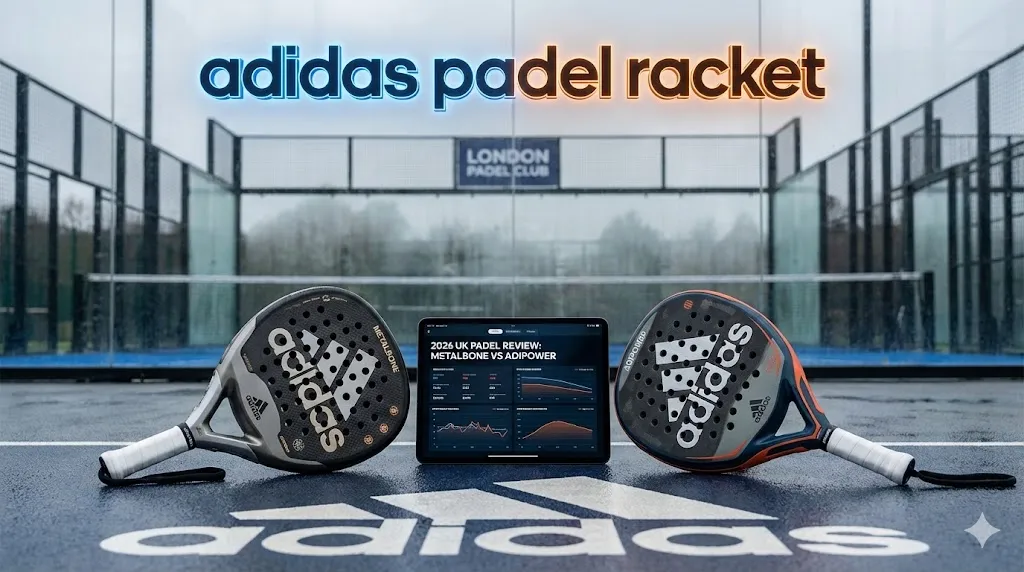
Furthermore, high humidity causes padel balls to absorb atmospheric water, rapidly increasing their active kinetic weight. Striking these heavy, wet balls places immense structural strain on the racket face. A premium 16K frame utilizing a 100% carbon tubular construction is highly resistant to this moisture infiltration. For comprehensive product insights, reviewing an authoritative adidas metalbone hrd 2026 review reveals how advanced aluminised carbon skins act as vital barriers, keeping structural performance steady when weather conditions deteriorate.
Aerodynamic Drag and Advanced Hole Geometry Engineering
Heavy, humid air dramatically increases aerodynamic drag during the rapid accelerations required for high-level overhead shots. To overcome this environmental resistance, top-tier manufacturers design complex frame dynamics and customized hole distributions. Without these structural pathways, swinging a wide 38 mm frame through damp air feels sluggish, causing slight timing disruptions that ruin clean ball contact.
Modern 16K rackets combat drag by using graduated hole diameters across the surface. Smaller central holes preserve the structural density and power of the core, while wider peripheral holes bleed off air resistance during high-speed swings. This layout optimizes airflow, letting you maintain peak head speed through heavy air. Selecting a model from a premium Babolat padel racket line shows how targeted aerodynamics can instantly refine control at the net.
- Airflow Paths: Specialized cutouts near the bridge smoothly vent air to minimize drag.
- Graduated Patterns: Varied hole sizes reduce frame weight while maximizing structural strength.
- Manoeuvrability: Reduced drag lets players react faster during intense net exchanges.
The Lightweight-Rigidity Paradox & Biomechanical Protection
A dangerous trend in modern padel selection is the assumption that choosing an ultra-lightweight racket is the easiest way to prevent arm strain. In truth, matching a very light frame (under 355 grams) with a highly rigid carbon face creates a severe lightweight-rigidity paradox. Because an ultra-light frame lacks the raw physical mass needed to absorb heavy ball impacts, dangerous high-frequency shockwaves travel directly into the player’s arm joints.
For advanced players executing high-power shots against heavy balls, moving to a balanced middleweight frame (360 to 365 grams) provides natural shock absorption. Combining a stable 16K face with built-in frame dampeners and a flexible core effectively mitigates the risk of epicondylitis. If you are experiencing joint pain, researching the best padel rackets for tennis elbow will show how proper structural mass is vital to protecting your arm over a demanding competitive season.
Frequently Asked Questions (FAQ)
What is the primary difference between a 12K and a 16K carbon face on outdoor UK courts?
A 16K face utilizes wider, flatter carbon ribbons than a 12K pattern, offering a more uniform feel and a larger sweet spot. This extra compliance prevents the racket from feeling excessively stiff when cold UK temperatures naturally harden the internal foam core.
How does high humidity affect the lifespan and structural memory of a 16K racket?
High humidity forces padel balls to hold water, increasing impact stress on the racket face. Premium 16K frames use 100% carbon tubular frames and moisture-sealed epoxy resins to prevent structural softening, outlasting cheap composite alternatives.
Why should advanced players avoid budget composite frames in competitive UK padel leagues?
Budget composite frames often rely on cheap fiberglass layers that warp and lose elasticity under heavy use. A genuine 16K carbon face retains its structural memory over long periods, delivering the consistent ball output and power advanced rallies require.